
Magento to BigCommerce Migration: Cutting Costs Without Losing Features
This article treats a Magento to BigCommerce migration as a total cost of ownership decision. The pressure usually starts with four line…
Read MoreSome Volusion stores are bigger businesses than the platform was designed for: tens of thousands of parts, prices that differ by account, more than one brand, an ERP that wants to own inventory. Magento is built for that, and it is software you own. We turn Volusion's products and options into a real attribute-driven catalog, bring every customer and order, build a fast Hyvä storefront, and redirect each old URL to its new home.
15
Fifteen years of building, migrating, and growing online stores for B2B and B2C brands.
30+
SEO, AI search, paid media, design, and development experts under one roof.
USA
A US-based core team you talk to directly, backed by vetted specialists worldwide.
4.9
Average score across 650+ verified client reviews.
Volusion to Magento
This is the longest jump on the map: from a hosted platform that decides most things for you to one where almost everything is a decision. We make those decisions with you up front, so the build is predictable. The work is led by our Magento development team, with Volusion specialists handling the export.
What the business needs that Volusion could not give it, mapped to Magento Open Source or Adobe Commerce, with hosting, the yearly running cost, and who will maintain the platform all settled before the project is priced.
Volusion keeps product detail in fixed fields and free text. We extract it into Magento attributes and attribute sets, so size, material, fitment, or voltage become filters and search terms, and options and child products become configurable products with proper simple SKUs.
The full catalog with images, customers with addresses, and the order history imported by script and reconciled against the Volusion exports. Customers set a new password at first sign-in; nothing else about their account changes.
Volusion's price levels and customer-specific discounts become customer groups, tier prices, and price rules; where buyers need company accounts, shared catalogs, quotes, and purchase order approval, Adobe Commerce B2B is configured and tested with real accounts.
A new storefront on the free, open-source Hyvä theme, designed for large-catalog navigation: layered filters, fast search, quick order forms, and pages that pass Core Web Vitals on a phone in a warehouse aisle.
Inventory, pricing, and orders connected to your ERP or accounting system through Magento's APIs, multi-source inventory set up for each warehouse, and shipping, tax, and email tools reconnected and tested with real orders. See our NetSuite work for an example.
If you run several Volusion stores, or want a separate wholesale site, they can become storefronts on one Magento installation sharing a catalog, customers, and an admin, each with its own design and prices.
Every Volusion address, from ProductDetails.asp links to -p/ and -s/ paths and articles, is mapped to a clean Magento URL and loaded into the rewrite table as a 301, with metadata, canonicals, and structured data in place before launch.
A load test, a security review, a rehearsed cutover with a final data sync, and daily monitoring for two weeks, followed by ongoing support for patches and upgrades so the store stays on a supported release.
Why merchants move
Most Volusion merchants are better served by a hosted platform, and we will point you to one if that is you. Magento is for the minority whose business has real complexity. It costs more to run than anything else on this page, and in return it stops being the thing that limits what the business can do online.
Hundreds of thousands of SKUs, any number of attributes, configurable, bundled, and grouped products, and search that stays fast as the range grows.
Customer groups, tier prices, shared catalogs, and negotiated quotes let each buyer see their own terms, which Volusion's price levels could only approximate.
Open APIs and a mature integration ecosystem mean stock, pricing, and orders can flow to and from the system that runs the business.
Brands, regions, and a wholesale portal as separate storefronts on a single installation, managed from one admin.
Open source code on your own hosting, with no platform fee on sales and no vendor whose roadmap you depend on.
The catalog is modest, pricing is simple, and nobody on the team wants to manage hosting and upgrades. Then BigCommerce gives you most of the benefit for far less upkeep.
On every Volusion to Magento migration
Because this route carries the most moving parts, we commit to the following on each project:
If Magento sounds like more platform than you need, or you are coming to it from somewhere other than Volusion, the routes alongside this one are below, with the free audit to scope whichever fits.
Six steps across fourteen to twenty weeks: settle requirements and edition, design the data model, script and rehearse the migration, build the storefront and integrations, test under load, and go live with support in place.
Needs, edition, hosting, running cost, and a fixed project price. The free migration audit is a useful first pass.
Attributes, attribute sets, product types, customer groups, and the URL scheme designed from your Volusion data and signed off.
Catalog, customers, and orders imported into staging by script, reconciled, corrected, and re-run until the totals agree.
The Hyvä storefront, pricing rules, and B2B features built while ERP, inventory, shipping, and tax connections are developed and tested.
Performance and security checks, URL rewrites imported and crawled, a final sync, and DNS changed at a quiet hour.
Two weeks of close monitoring, admin training, then a standing schedule of security patches and version upgrades.
Businesses that needed more from their platform than it could give, and moved without losing their place in search or their customers' history.
Rob
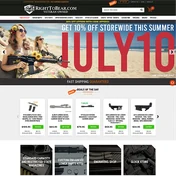
Right To Bear, righttobear.com
★★★★★
“I had a great experience working with the team at MAKdigitaldesign. Will definitely come back for future projects. Our BigCommerce store looks great, and everything was done in a timely and orderly fashion.”
Daniel Johnson
★★★★★
“We did a major upgrade to our ecommerce site and are extremely happy with the results. We got excellent advice and customer support before, during and after the project.”
PMArmory
PMArmory
★★★★★
“Teaming up with MAK is a total thrill! We're over the moon with our brand-new website. Alexis was all ears for our needs and hatched a plan that checked all our boxes. Her communication skills throughout the whole process were simply top-notch.”
Tell us about your catalog, your pricing, and the systems behind the store. We will reply with an edition recommendation, a yearly running cost, and a fixed price, or with a simpler platform if that suits you better.
Fit, editions, running cost, catalog modeling, pricing, ERP, storefronts, SEO, and timing.
Merchants with large or highly attributed catalogs, prices that vary by account, several brands or storefronts, or an ERP that must drive stock and pricing. If none of that applies, a hosted platform such as BigCommerce or Shopify will cost less and ask less of you, and we would recommend it.
Open Source has no license fee and covers catalog, pricing rules, customer groups, multiple storefronts, and multi-source inventory. Adobe Commerce adds company accounts, shared catalogs, quotes, purchase order approvals, content staging, and vendor support, for a license from about $22,000 a year. We choose based on which B2B features your buyers will really use.
Plan for hosting with search and caching services, security patches through the year, an annual version upgrade, and developer time, plus the Adobe Commerce license if you choose it. A published estimate for mid-market stores is $50,000 to $150,000 a year. We put your own figure in the proposal so the comparison with Volusion is honest.
Product data is pulled out of Volusion's fields and descriptions into structured attributes. Options and child products become configurable products with a simple product per SKU. Categories are rebuilt with layered navigation, so customers can filter by the attributes that matter in your trade.
Yes. Customer groups and tier prices cover most cases on Open Source, and Adobe Commerce adds shared catalogs and negotiated quotes per company. Where prices live in your ERP, they can be synced so the store always shows each account its current terms.
That is one of the main reasons to choose it. Magento's APIs support two-way sync of products, stock, prices, customers, and orders, and connectors exist for the common ERPs. We scope the integration during requirements and test it with real orders before launch.
Yes. Each can become a storefront on one Magento installation, with a shared or separate catalog, shared customers if you wish, and its own design and domain. That usually cuts the administrative work considerably.
They are protected the same way on every route: we crawl the Volusion store, collect the URLs search engines have indexed, map each to its new Magento address, and load one-to-one 301s into the rewrite table before launch. Metadata and structured data move too, and we monitor daily for two weeks.
Hyvä. Its core theme has been free and open source since November 2025, it is far lighter than Magento's older front end, and it makes passing Core Web Vitals straightforward. Hyvä Checkout and the Adobe Commerce compatibility packages are paid add-ons that we include only when a project needs them.
Fourteen to twenty weeks is typical, and longer when an ERP integration or several storefronts are involved. Projects generally start in the mid five figures and reach six figures for enterprise scope. The project price is fixed after requirements, and the yearly running cost is stated next to it.
From the eCommerce Experts
This article treats a Magento to BigCommerce migration as a total cost of ownership decision. The pressure usually starts with four line…
Read MoreMost Magento merchants focus exclusively on standard SEO tactics, completely overlooking the goldmine that is local search optimization. Here’s the reality: 46%…
Read MoreThe online firearms industry has grown fast, but so have the rules and restrictions that come with selling guns, ammunition, and tactical…
Read MoreTwice a month: what changed in Google and AI search, what it means for your store, and exactly what to do about it. Written by the people who build and rank stores for a living.
First issue lands within two weeks. Check your inbox for a hello from us in the meantime.