Unisan Direct
The published case documents a Magento to BigCommerce project. Its narrative covers the source Magento implementation, a custom Stencil theme and B2B requirements.
Read the published case We help you sell moreRequest a Free Quote
A move from Magento or Adobe Commerce to BigCommerce needs more than a catalog import. MAK Digital helps merchants discuss the data, storefront requirements and operational dependencies that determine the replatforming scope.
Start with the current edition, implementation and customizations. The useful question is which business behaviors must continue and how each will be delivered in the destination store.
Compare data-only work with a full replatform in our eCommerce data and platform migration services. Define the record inventory, exclusions, trial transfer and launch acceptance before finalizing this BigCommerce route.
15
Fifteen years of building, migrating, and growing online stores for B2B and B2C brands.
30+
SEO, AI search, paid media, design, and development experts under one roof.
USA
A US-based core team you talk to directly, backed by vetted specialists worldwide.
4.9
Average score across 650+ verified client reviews.
What this work covers
What to identify: Representative product types, options, attributes and catalog structure
Decision needed before launch: Destination representation, mappings and exceptions
What to identify: The actual behavior the business relies on
Decision needed before launch: Configuration, replacement app, custom work or an agreed change
What to identify: Required information, relationships and access expectations
Decision needed before launch: Transfer approach, supported behavior and exclusions
What to identify: External systems and source-of-truth responsibilities
Decision needed before launch: Reconfiguration or rebuild scope and workflow checks
What to identify: Important destinations, content and search requirements
Decision needed before launch: Content transfer, URL decisions and redirect review
What this work covers
Record the customer or staff behavior behind each customization. Two tools with similar names may handle data or workflows differently. A destination choice should be tested against the requirement rather than assumed to be an identical replacement.
If the store supports business customers or other complex requirements, document those workflows explicitly. Any unsupported or changed behavior needs a decision before the migration is accepted.
What this work covers
The full replatform may include design, development and integration changes in addition to moving records. Use BigCommerce store migration services for that connected discussion.
If another team owns the destination build, a narrower BigCommerce data migration scope should identify its boundaries. Integration work can be discussed through BigCommerce API services.
Another direction, or BigCommerce from a different platform? We run these routes too, and the free audit builds your task list in two minutes.
What this work covers
Agree on representative catalog and workflow checks, data reconciliation, release responsibilities and the approach to changes made while the destination is being prepared. Document who approves the launch and what happens if an acceptance check fails.
Include relevant SEO and URL review in that plan. Moving platforms does not guarantee unchanged search performance, and technical acceptance is not a traffic forecast.
Published Magento to BigCommerce work. Each case describes its own project; the scope for another store is agreed separately.
The published case documents a Magento to BigCommerce project. Its narrative covers the source Magento implementation, a custom Stencil theme and B2B requirements.
Read the published caseStores that left self-hosted platforms for BigCommerce with us and kept everything that mattered.
Webeyecare
★★★★★
“If you're a BigCommerce user, hitting up MAKDigital is a smart move. It's a hive of skilled web designers and coders. Rest assured, they'll deliver what you're looking for.”
Anthony DiCicco
ProDryers
★★★★★
“MAK is literally my go-to developer for Volusion and BigCommerce. I have used Mary many times and will continue to do so. I have not found a more reliable and knowledgeable person to handle all of our technical issues with both platforms. I made the mistake of going with a company that I thought was bigger and better. I ended up having to hire MAK to fix all of their mistakes that would have cost me hundreds of thousands in lost sales. It's important to have a full understanding of the database structures and business rules of each platform. MAK really understands the fine details behind these platforms. MAK has truly earned my trust for life.”
Kirsten Logan
Clava.com
★★★★★
“Mary is the person you need to know and work with if you have a Volusion site. She is incredibly knowledgeable about all things Volusion and we couldn't have set up our store the way we wanted to without her, and it looks great! Thank you Mary and Mak Digital.”
Send us your store URL. We will reply with a fit assessment, what BigCommerce can and cannot hold from your Magento setup, the task list, and a fixed price.
Versions and editions, cost, catalog translation, B2B, extensions, SEO, downtime, and timelines.
Cost of ownership and maintenance. Hosting, security patches, version upgrades, extension renewals, a developer retainer, and for Adobe Commerce a license priced on revenue add up to three-year totals in the hundreds of thousands for a mid-market store. BigCommerce removes the servers and most of the retainer, keeps native B2B and open APIs, and charges a known plan price. Stores that need Magento's custom logic or data residency should stay, and we will say so.
Yes. Magento 1 has been end of life since 2020 and is the most common source we see; Magento 2 Open Source, Mage-OS, and Adobe Commerce (including B2B) migrate the same way with their own mappings.
Attribute sets become custom fields and metafields; configurable products become products with options (250 values each, 600 SKUs per product); bundles and grouped products become pick lists and groupings; downloadable products become digital products. The audit flags any product that would exceed a limit so it is planned, not discovered.
Customer groups and tier pricing become customer groups and price lists; Adobe Commerce B2B companies, approvals, quotes, requisition lists, and purchase orders are rebuilt in BigCommerce B2B Edition with company hierarchies, buyer roles, net terms, and quick order, and verified with real buyer accounts before launch.
Each is matched to a BigCommerce app, a native feature (reviews, cart recovery, shipping quotes, promotions, and faceted search are built in), or a custom integration through the APIs; the audit lists every one and its replacement before you commit.
BigCommerce charges nothing on its embedded payments and, from June 2026, an Open Payment Provider Fee of roughly 2, 1, or 0.6 percent by plan on third-party gateway, offline, and purchase order orders. We model it against your current gateway and Magento costs in the fit assessment.
No; Magento password hashes cannot be imported. Customers, addresses, groups, and history move; we plan a reset campaign with your email tool so returning customers log in once and continue.
Not with the SEO workstream we run: a crawl and rankings baseline, one-to-one redirects for every indexed URL and URL rewrite into a structure BigCommerce lets you keep, metadata and schema carried across, and daily monitoring for two weeks. Badly redirected migrations lose 20 to 50 percent of organic traffic; ours are built to lose none.
No. The Magento store sells until the final delta sync; DNS switches at a quiet hour with redirects already live, and the old store stays available until the last order is confirmed on BigCommerce, after which the servers are decommissioned.
Ten to sixteen weeks for most stores, longer with enterprise B2B, many store views, or ERP in the critical path. Cost depends on catalog complexity, B2B scope, the storefront, and integrations; the quote is fixed after the audit, and some BigCommerce migrations qualify for our free migration offer.
Yes. Identify the actual implementation and required behavior during discovery, including extensions and customizations. Do not assume the same transfer and replacement scope applies to every store.
Treat their business functions as requirements to evaluate. The destination may need different configuration, apps or implementation. Record any differences and the review criteria for the replacement behavior.
A decision needs the actual subscription, app, implementation and ongoing operating costs for the proposed setup. Do not treat a platform change alone as a guaranteed saving.
Yes. The scope review should identify what each extension does and whether the requirement can be handled by BigCommerce, an app, an integration or custom development. Moving an extension itself is not the same as preserving its business function.
From the eCommerce Experts
This article treats a Magento to BigCommerce migration as a total cost of ownership decision. The pressure usually starts with four line…
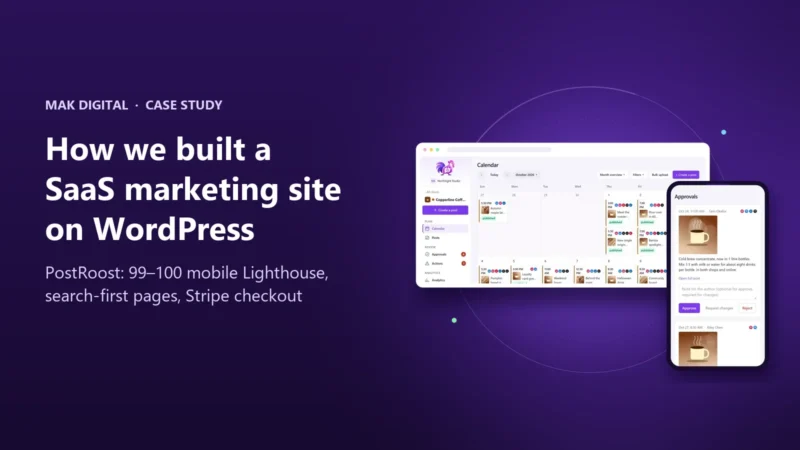
Read More: Magento to BigCommerce Migration: Cutting Costs Without Losing FeaturesThe decisions behind the PostRoost marketing site: why it is separate from the app, how the theme stays fast, how search intent…
Read More: How We Built a SaaS Marketing Site on WordPressOur perspective is not platform-neutral in the abstract: MAK Digital Design is an ecommerce design, development, and digital marketing agency that works…
Read More: BigCommerce vs Shopify for SEO: An Elite Partner’s Honest ComparisonChoosing MAKDigital means partnering with a team of experienced professionals dedicated to your success. We offer tailored solutions, expert advice, and a commitment to delivering exceptional results. Our focus on innovation and customer satisfaction sets us apart in the eCommerce industry.
Twice a month: what changed in Google and AI search, what it means for your store, and exactly what to do about it. Written by the people who build and rank stores for a living.
First issue lands within two weeks. Check your inbox for a hello from us in the meantime.