Holiday eCommerce Tips 2026: Boost Sales with Mobile & AI

With the holiday season just around the corner, eCommerce businesses are preparing for a high-stakes period of increased traffic, eager shoppers, and record-breaking sales potential. Each holiday season brings evolving trends that reflect shifts in consumer behavior and technology. In 2025, U.S. shoppers spent a record $257.8 billion online in November and December, up 6.8% from the year before, and most of it came through a phone, according to Adobe Analytics. For 2026, Adobe forecasts $275.1 billion, up 6.7%. By learning from last year’s successes, brands can strengthen their eCommerce holiday readiness for 2026 and make the most of the season’s opportunities.
Updated October 2026. We first published this guide for the 2024 holiday season and have revised it for 2026, with last season’s results and this year’s forecasts in place of the 2023 and 2024 figures.
What Changed Between the 2024 and 2026 Editions
The seven trends in the original guide all held. What changed is how far each one has gone:
- AI became a shopping channel. Traffic to U.S. retail sites from generative AI tools rose 693.4% during the 2025 holiday season, and Adobe expects it to more than double again this year.
- Mobile became the majority. Phones accounted for 56.4% of online holiday sales in 2025, up from 54.5% in 2024.
- Buy Now, Pay Later hit a record. Shoppers put $20 billion on BNPL plans last season, up 9.8%.
- Social grew fastest. Social media’s share of online holiday revenue rose 40.3% in a year.
- Shoppers stayed careful. Sales are forecast to grow again, but planned gift budgets are slightly down, so value decides who wins the order.
Consumer Confidence and the Value-Focused Shopper
Shoppers are still spending, and they are careful about how. Deloitte expects holiday retail sales to grow between 4% and 4.8% this season and eCommerce sales to grow 7.5% to 8.4%, and it describes “value-seeking behaviors across income levels, including switching among brands and retailers and using promotions to manage spending.” PwC’s 2026 Holiday Outlook points the same way: average planned gift spending is $708, down 2% from last year. Shoppers favor brands that offer real value, competitive pricing, and exclusive discounts, and they will keep making cost-effective choices during the eCommerce holidays.
How to prepare:
- Promote Value and Quality: In your eCommerce holiday planning, highlight the quality and unique value your products offer. Customers are more likely to buy if they feel they’re making a smart purchase.
- Launch Early Deals and Loyalty Discounts: Kickstart your eCommerce holiday readiness by launching early holiday promotions. Adobe expects discounts of up to 14% in early November, building to as much as 30% off during Cyber Week, which runs from Thanksgiving on November 26 through Cyber Monday on November 30 this year. Exclusive discounts for repeat customers or loyalty members can incentivize early and frequent shopping.
 Long Island Watch early Black Friday sale
By focusing on value-driven promotions, your business can attract deal-oriented customers while also fostering customer loyalty.
Mobile-First Shopping Experience
Mobile is now where most holiday shopping happens. Phones accounted for 56.4% of U.S. online holiday sales in 2025, and Adobe expects 57.4% this season. During Cyber Week 2025, Salesforce counted 70% of online orders coming from mobile devices, with mobile wallets used for 29% of U.S. orders. With that many shoppers browsing and buying on a phone, a seamless mobile experience is essential for eCommerce holiday readiness. Consumers, particularly younger generations, expect fast load times, intuitive navigation, and quick checkout processes when shopping on mobile during the eCommerce holidays.
How to prepare:
- Optimize Your Site for Mobile Performance: As part of your eCommerce holiday planning, ensure you prioritize mobile optimization. Remove unnecessary steps, streamline navigation, and focus on creating a smooth user experience. Our free speed check shows how your key pages load on a phone before the traffic arrives.
- Offer Mobile-Friendly Payment Options: Integrate one-click payment methods, like Apple Pay and Google Pay, to simplify checkout on mobile. This feature is especially important during peak eCommerce holidays when convenience can make or break a sale.
 Examples of our clients’ mobile-optimized sites
Prioritizing mobile optimization will reduce cart abandonment and create a smoother shopping experience for on-the-go holiday shoppers.
Social Commerce and Live Shopping
Social media has become a powerful channel for eCommerce, allowing brands to connect with consumers in real time. Its share of U.S. online holiday revenue rose 40.3% in 2025 to 4.6%, by Adobe’s count, while affiliates and partners, a group that includes influencers, drove 20.4%. Adobe expects social’s share to grow another 17% this season. Platforms like TikTok and Instagram have proven effective for live shopping events, capturing impulse buys and creating a sense of community. Social commerce lets consumers discover, engage, and purchase products within their preferred platforms. Much of its value comes before the sale: in PwC’s survey, 29% of consumers use social media to decide what to give, while 9% expect to buy there.
How to prepare:
- Engage with Interactive Content: Plan live shopping events where you can showcase products, offer exclusive deals, and answer customer questions. These events foster engagement and encourage real-time purchases, enhancing your eCommerce holiday readiness.
- Leverage User-Generated Content: Share customer reviews, photos, and testimonials to provide social proof and build trust. User-generated content is especially influential during the eCommerce holidays when customers are looking for trusted recommendations.
- Make the Path From Post to Product Short: Because far more shoppers find gift ideas on social media than buy there, link each post, video, and creator code to the exact product page, and make sure that page loads fast on a phone.
Incorporating social commerce strategies in your eCommerce holiday planning helps create a dynamic and engaging shopping experience for today’s social-savvy customers.
Smarter Shopping Tools for Informed Purchases
Today’s consumers are more tech-savvy, using digital tools like wish lists, price alerts, and personalized recommendations to make informed buying decisions. Price comparison is now part of that toolkit: among shoppers who plan to use AI this season, 55% will use it to compare prices, according to PwC. These tools empower shoppers to monitor deals, compare products, and make confident purchases, making them valuable assets in eCommerce holiday planning.
How to prepare:
- Introduce Digital Wish Lists and Price Tracking: Allow customers to save products and receive notifications when prices drop or when items are low in stock. This keeps your brand top of mind and encourages return visits.
- Use AI-Driven Personalization: Implement AI tools that analyze customer preferences to offer relevant product recommendations. Personalized suggestions are powerful during the eCommerce holidays, guiding customers to products they’re more likely to buy.
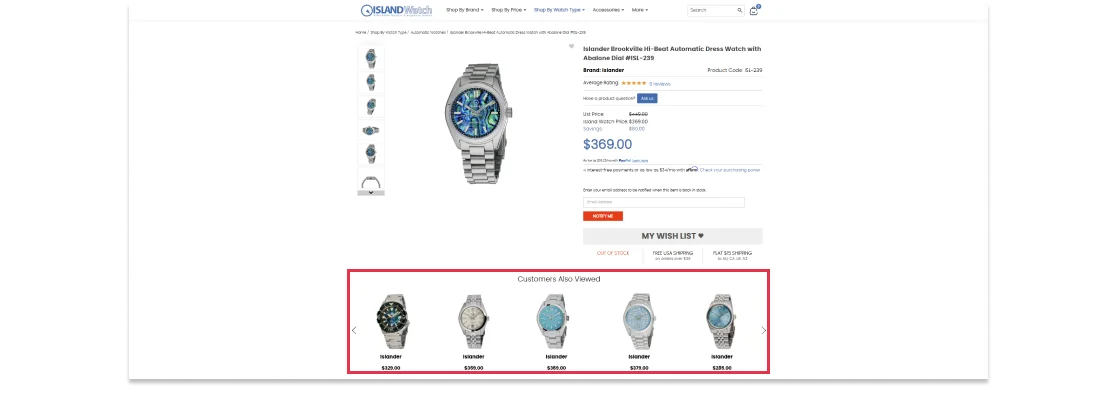 Long Island Watch product recommendations
Integrating smart shopping tools strengthens eCommerce holiday readiness by helping customers make confident, informed purchases.
Buy Now, Pay Later (BNPL) Options for Greater Flexibility
Buy Now, Pay Later (BNPL) set a record last season: shoppers spent $20 billion online through BNPL plans in November and December 2025, up 9.8%, and Cyber Monday alone passed $1 billion, according to Adobe. For 2026, Adobe forecasts $21.3 billion, with about 82% of it coming from phones. BNPL allows customers to split payments, making holiday shopping more manageable. This flexibility has made BNPL a must-have for successful eCommerce holiday planning.
How to prepare:
- Partner with BNPL Providers: Offer BNPL options like Klarna, Afterpay, or Affirm to attract customers looking for payment flexibility.
- Feature BNPL Options Prominently: Display BNPL availability on product pages and at checkout to remind shoppers that they have flexible payment options. Since most BNPL orders are placed on a phone, check how the offer looks on a small screen first.
Adding BNPL options can improve your eCommerce holiday readiness by increasing average order value and making your products accessible to a broader audience.
Generative AI for Product Discovery, Personalization, and Customer Support
In 2024, generative AI was mostly a tool for retailers. In 2026, shoppers use it too. Traffic to U.S. retail sites from generative AI tools rose 693.4% during the 2025 holiday season, and Adobe expects it to grow another 130% this year. In PwC’s survey, 29% of consumers plan to use AI somewhere in their holiday shopping, up from 22% a year ago, mostly to research products and compare prices. Salesforce estimates that AI and agents influenced 20% of all orders worldwide during Cyber Week 2025. On the retailer’s side, AI still provides personalized marketing and efficient customer service, and AI can help brands deliver tailored shopping experiences and streamline customer support.
Buying inside an AI assistant is arriving more slowly. Google announced its Universal Commerce Protocol in January 2026, and checkout inside Google’s AI Mode and Gemini is in early access for select U.S. merchants. For this season, plan on assistants sending shoppers to your store to complete the purchase, and make sure the page they land on answers their question.
How to prepare:
- Make Your Store Readable by AI Assistants: Assistants recommend what they can understand. Keep product titles, prices, availability, shipping, and return details complete in your product feed and your structured data. Our free AI visibility check and schema check show what an assistant can read on your pages today.
- Use AI for Personalized Marketing: Generate customized email campaigns, product recommendations, and targeted ads to create meaningful connections with customers.
- Implement Chatbots for Customer Support: Deploy AI chatbots to assist customers with frequently asked questions, product inquiries, and order updates. This level of eCommerce holiday readiness ensures customers receive timely support without overloading your team.
Generative AI can significantly enhance eCommerce holiday planning by providing scalable solutions that improve efficiency and customer satisfaction. Adobe’s survey suggests it helps after the sale as well: 77% of shoppers who use AI say they feel more confident in their purchases, and 69% say they are less likely to return them.
The Influence of Generation Alpha and Digital Wish Lists
Generation Alpha, the youngest consumer demographic, has a real say in holiday shopping, especially through wish lists shared with family members. In a PwC survey of children aged 7 to 14 published in March 2026, 61% said they add the things they want to birthday or holiday wish lists, and 61% named social media as a reason they want to buy something. The budgets follow: households with children plan to spend $875 on gifts this season, compared with $635 for households without. Digital wish lists simplify the shopping process and offer retailers valuable insights into popular products, making them essential for eCommerce holiday planning.
How to prepare:
- Offer an Easy-to-Use Wish List Feature: Make it simple for customers to create, save, and share wish lists. This feature is particularly useful for families buying items selected by younger relatives.
- Promote Holiday Gift Guides: Help customers find popular items by curating gift guides or themed collections, appealing to families and gift-givers during the eCommerce holidays.
Digital wish lists are an effective tool for enhancing eCommerce holiday readiness by meeting customers’ needs for convenient and organized shopping.
Conclusion
The 2026 holiday season brings opportunities for growth and innovation in eCommerce. By understanding and adapting to these trends, like mobile-first optimization, social commerce, AI-driven discovery and personalization, and flexible payment options, your business can build a strong foundation for eCommerce holiday readiness.
Proactive eCommerce holiday planning is essential to standing out in a crowded market, building customer loyalty, and maximizing sales during this crucial season. As the holidays approach, focus on creating a seamless, engaging, and value-driven shopping experience to capture attention and turn visitors into loyal customers.