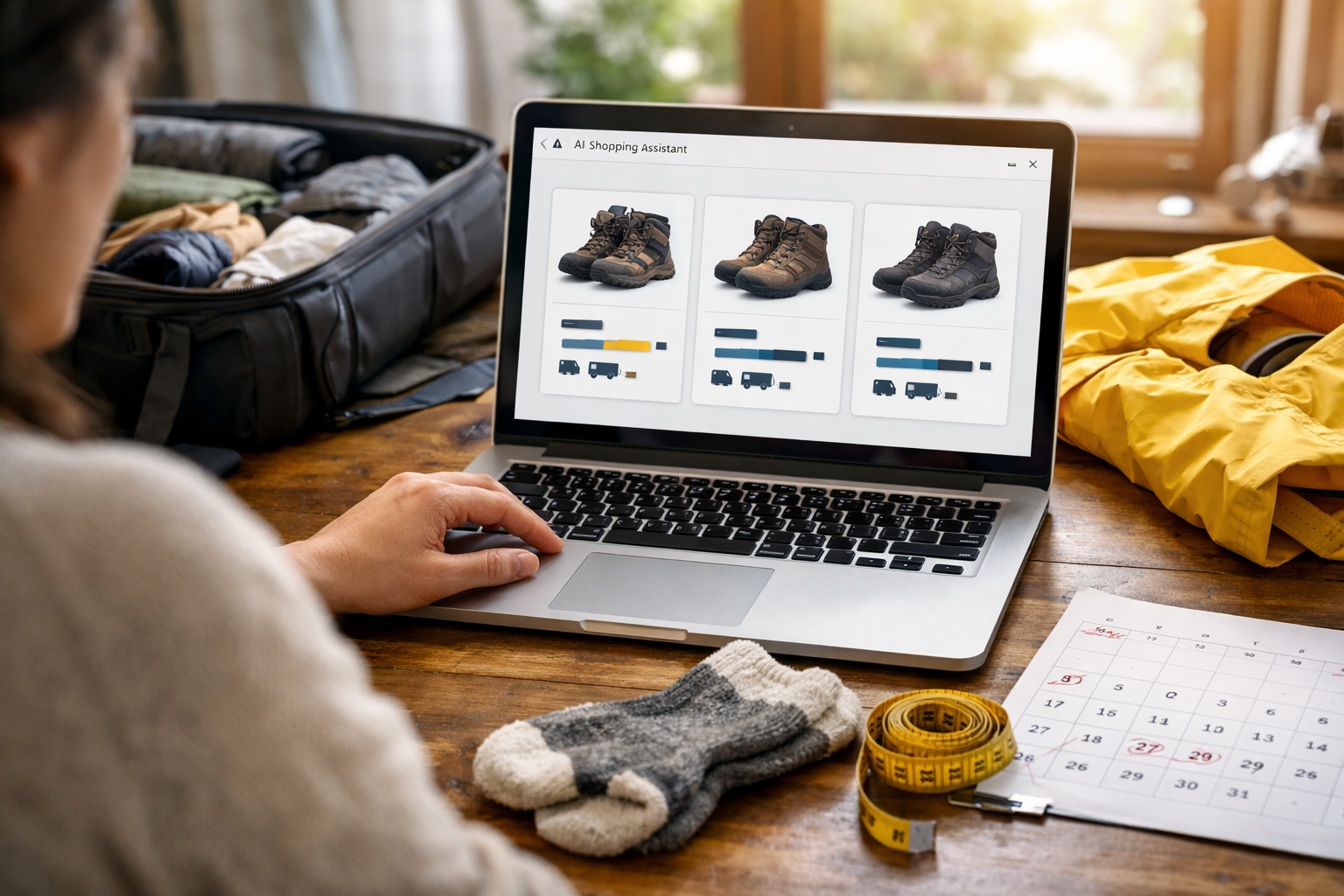
Store-side AI search work

eCommerce AI Optimization: Make Your Store Readable to AI Shopping Answers

AI shopping answers can only describe your products as accurately as your store describes them. eCommerce AI optimization is the store-side work: product and category pages that state the facts shoppers ask about, structured data and feeds that agree with those pages, and crawler rules you chose on purpose. MAK Digital's team implements it on Shopify, BigCommerce, WooCommerce and Magento as part of our SEO plans.

Since 2012
Building and growing online stores
30+
In-house specialists
800+
Projects delivered

MAK Digital at a glance

  • 15

    Years in eCommerce

    Fifteen years of building, migrating, and growing online stores for B2B and B2C brands.

  • 30+

    In-house specialists

    SEO, AI search, paid media, design, and development experts under one roof.

  • USA

    US-led, globally staffed

    A US-based core team you talk to directly, backed by vetted specialists worldwide.

  • 4.9

    Client rating

    Average score across 650+ verified client reviews.

What we implement

Our eCommerce AI Optimization Services

Every item below is a change made on your store, not a report left for your developers. We scope it from your templates and catalog, so a 300-product store and a 40,000-SKU parts catalog get different work.

  • Product and category content that answers shopper questions

    We rewrite product and category templates so the facts a shopper asks an assistant about (fit, dimensions, materials, compatibility, what is in the box, who it is not for) appear as text on the page, near the top, in consistent wording across the catalog. For large catalogs, attribute enrichment at scale runs through our catalog content and attribute enrichment service.

  • Product structured data that matches the page

    We audit what your theme and apps actually output, remove duplicate or conflicting blocks, and ship one clean Product and Offer graph per page: price, currency, availability, condition, brand, gtin or mpn, variants grouped with ProductGroup, plus shipping details and a return policy. Google's guidance is that markup should match the visible text, so the page and the markup are fixed together.

  • Page, markup and feed parity

    Your price, stock status, title and identifiers live in at least three places: the visible page, the JSON-LD and the product feed. We compare all three on a sample of products, trace each mismatch to its source (a sale app, a cached feed, a theme snippet) and fix the source rather than the symptom.

  • AI crawler policy and robots.txt

    We review robots.txt, firewall and bot-protection settings, then set a written policy for each documented crawler: search crawlers, user-triggered fetchers and training crawlers are treated separately. You decide the policy; we implement it and record why.

  • Rendering of product facts

    Google recommends that important content is available in textual form, and we do not assume every crawler executes JavaScript. If price, availability, specifications or reviews appear only after scripts run, that is a risk we remove. We check the raw HTML of key templates and move the product facts and the structured data into the server-rendered response where the platform allows it.

  • Shipping, returns and store policy pages

    Delivery cost, delivery time and return windows are facts an answer can get wrong if they live only in a checkout step or a PDF. We make sure policy pages state the terms in plain text, that product pages link to them, and that the same terms appear in OfferShippingDetails and MerchantReturnPolicy markup, with one store-wide return policy referenced from the Organization.

Scope

What eCommerce AI Optimization Covers

We judge every product template against three tests. Each one is ordinary technical SEO applied to product data, which is why this work sits inside our eCommerce SEO services rather than in a separate AI product.

Readable, consistent, accessible: the three tests

  • Readable: the facts a shopper would ask about are on the page as text, in the server response, with clear labels. A spec table that loads from a third-party widget after the page renders fails this test.
  • Consistent: the page, the structured data, the feed and the policy pages say the same thing about price, stock, shipping and returns. An assistant that reads two different prices has to pick one, and it may not pick yours.
  • Accessible: the crawlers you want to reach the store can reach it. That means robots.txt, but also firewall rules, bot challenges and geo-blocks that a store owner may never have looked at.

Where this sits next to GEO, AEO and agentic commerce

Several MAK services touch AI answers. This page is the on-site layer for stores. Brand mentions, reviews and citations on other websites belong to generative engine optimization. Question research and answer-first content across the whole site belongs to answer engine optimization. Agents that add to cart and complete checkout, and the protocols behind them, belong to agentic commerce readiness. How the layers fit into one program is set out on our AI search optimization hub.

Documented mechanisms

How AI Shopping Answers Get Your Product Data

Each assistant documents a different route from your store to its answer. We plan the work from what the platforms publish, as of November 2026, and we keep documented behaviour apart from patterns we observe and theories nobody has confirmed.

Google AI Overviews and AI Mode

Google's Search Central documentation says a page must be indexed and eligible to show in Search with a snippet to appear as a supporting link, and that there are no additional technical requirements. In the same document Google says no new files or special schema.org types are needed for these features. What it does recommend is directly relevant to stores: important content available in textual form, structured data that matches the visible text, and up-to-date Merchant Center information. For a store, that makes the Merchant Center feed and the product page two halves of the same job.

ChatGPT search and shopping

As of November 2026, OpenAI's help center describes product results built from structured metadata (price, description and similar fields) supplied by first-party and third-party providers, plus other third-party content, and states that product results are not ads. Shopify merchants are connected through Shopify Catalog without extra work; merchants on other platforms can apply for direct product feed access. OpenAI also warns that changes to pricing or shipping terms may take a while to show. It does not say ChatGPT reads the JSON-LD on your product pages, so we treat that as unconfirmed. Feed and merchant detail for ChatGPT is on our ChatGPT shopping optimization page.

Perplexity

For a store, the practical point in Perplexity's crawler documentation is the firewall. Perplexity says its search crawler, PerplexityBot, is what lets a site appear and be linked in its results, and that it does not collect training data for foundation models. It then gives web application firewall rules that match the user agent and Perplexity's published IP ranges, because a firewall or bot-protection layer can block its crawlers even when robots.txt allows them.

Other assistants

Anthropic, Microsoft and Google's Gemini apps document their own crawlers and grounding, and those pages change. Before we touch access rules we list the assistants your buyers actually use and read each one's current documentation. One working assumption runs through the whole service: an assistant that finds the same price, stock and return terms in every place it looks has less to reconcile. That is our reasoning from how these systems are documented, not a ranking rule any platform has published.


Method

The Parity Check: Page, Markup and Feed

Most of the accuracy problems we find are not missing markup. They are three systems disagreeing. Here is an illustrative example, not a client case: a pair of trail shoes shows $49 on the product page during a sale, the theme's JSON-LD still outputs the regular price of $59 because a sale app changes only the displayed price, and the feed sent overnight says $49. Google's guidance asks for structured data that matches the visible text, so the markup is now wrong. An assistant comparing sources sees two prices for one product.

How we run it

  1. Pick a sample: best sellers, products on sale, products with variants and products that were out of stock in the last month.
  2. Capture the visible price, availability, title, gtin or mpn and shipping cost from the rendered page.
  3. Capture the same fields from the raw HTML structured data and from the current feed.
  4. Log each mismatch with its cause: app override, caching, feed schedule, currency or tax setting, or a variant mapped to the wrong parent.
  5. Fix the source, then re-run the sample after the next price change or sale.

Variants are where parity breaks first

Another illustrative case: one shoe in four colours and six sizes is 24 sellable items. Google's merchant listing documentation supports grouping them with ProductGroup, linking each variant through isVariantOf and inProductGroupWithID, and giving each its own identifier. When a theme outputs only the parent product with one price and one availability flag, a shopper asking for a specific size can get a stock answer for a different size. We map every variant on the page, in the markup and in the feed to the same group ID.

Feed management and Shopping campaigns stay with our Google Shopping and feed management team; this service covers the parity between the feed and the store.

Access

Choosing Which AI Crawlers to Allow

Store robots.txt files often treat "AI bots" as one group, and bot protection on the CDN or storefront can block them again without anyone noticing. The platforms document three different kinds of access. The table below lists the user agents; this section is about the decisions a store owner has to make.

Search crawlers vs training crawlers vs user-triggered fetchers

  • Visibility in an assistant's search answers is governed by its search crawler. Disallow OAI-SearchBot and, per OpenAI, the store stops appearing in ChatGPT search answers apart from navigational links.
  • Use of your product copy for model training is a separate switch: GPTBot for OpenAI, the Google-Extended token for Gemini. Google says Google-Extended has no effect on inclusion or ranking in Google Search, so turning it off does not cost you Search or AI Overviews eligibility.
  • A shopper pasting your product URL into a chat triggers a user-initiated fetch (ChatGPT-User, Perplexity-User). OpenAI and Perplexity both say robots.txt may not govern these requests, so a robots.txt block is not a reliable way to stop them.

What blocking each one does

An illustrative policy for a store that wants to appear in AI answers without contributing training data: a User-agent: OAI-SearchBot group with Allow: /, a separate User-agent: GPTBot group with Disallow: /, and the same split for the other operators you care about. It is an example, not a default; some brands want their copy in training data and some have licensing reasons to keep it out. OpenAI says robots.txt changes take about 24 hours to reach its systems. Google's crawler documentation also notes a plan, for early 2027, to support the AIPREF shared training-preference signal; until it ships it changes nothing, and we will review policies then.

An llms.txt file is optional here: it is a community proposal, and Google says no AI text files are needed for its AI features. If you want one anyway, our llms.txt guide for eCommerce explains what it does and does not do.

Implementation

On Your Platform

The same three tests apply everywhere, but the places where markup, robots rules and feeds come from differ by platform. We implement in the theme or platform configuration, and test on a staging copy where the platform has one.

Shopify

Shopify generates a default robots.txt, and a theme can replace it with a robots.txt.liquid template; Shopify's developer documentation advises saving a copy of the current output and comparing before publishing. The usual markup problem on Shopify is two or three apps each printing a Product block. We keep one source, usually the theme. As of November 2026, OpenAI says Shopify merchants reach ChatGPT through Shopify Catalog, so the product data in your Shopify admin matters as much as the theme. Platform SEO work is on our Shopify SEO page.

BigCommerce

As a BigCommerce Elite Partner, we work in Stencil themes directly: product templates, the structured data the theme prints by default, and the custom fields that carry specifications. Custom fields that never reach the page as labelled text are a frequent gap. See our BigCommerce SEO service.

WooCommerce

WooCommerce stores (see our WooCommerce SEO work) often run WooCommerce's own product markup alongside an SEO plugin and a reviews plugin, each adding schema. We pick one owner for the Product graph, disable the rest, and check that variable products expose each variation.

Magento (Adobe Commerce)

Magento catalogs, which we support through Magento SEO, tend to be large, with configurable products, multiple store views and full-page caching. We check that cached pages carry the current price and stock in both the page and the markup, and that each store view outputs the right currency.

Catalog differences

What Changes by Catalog Type

Shoppers ask assistants very different questions depending on what they buy, so the attributes we prioritise change with the catalog.

Apparel and footwear

Variant modelling first: every size and colour as its own offer with its own stock status, plus fit notes, materials and care instructions as text. Sizing charts embedded as images are converted to text.

Parts and B2B catalogs

Manufacturer part numbers, cross-references and compatibility (which model, year or machine a part fits) carry most of the buying decision. We put compatibility in a structured, labelled table on the page and make sure mpn and brand are in the markup and the feed.

Home and furniture

Assembled dimensions, weight, materials, assembly requirements and freight delivery terms. Shipping details markup matters more here because delivery cost and time vary so much by product.

Health and beauty

Ingredients, sizes, skin or hair type and usage, written carefully. Claims on the page get stated as precisely as your compliance team allows, because an assistant may repeat them word for word.

Cost and results

What It Costs and How Results Are Reported

eCommerce AI optimization is included in MAK Digital's SEO plans, which start from $2,000/month. The share of the plan spent on templates, markup, parity and crawler work depends on your catalog size and platform; we set that in the proposal after the review.

No agency can promise that an assistant will pick your products. What store-side work can do is remove the reasons an answer would skip or misdescribe them: a blocked crawler, a stale price, a size that shows in stock when it is not. We report those fixes first, with the parity sample re-run after release. After that, our team checks a fixed panel of shopper prompts each month and reports which of your pages are cited and how products are described, through AI visibility tracking. Google's documentation notes that traffic from AI Overviews and AI Mode is counted within overall search traffic in Search Console, so we report it alongside your organic results rather than as a separate channel.

Crawler reference

AI Crawlers and Controls an Online Store Should Know

What each platform documents, as of November 2026. Check each operator's documentation before changing rules; these pages are updated without notice.

Documented purpose and effect of blocking for common AI crawlers and control tokens (sources: OpenAI, Perplexity and Google documentation, checked 2026-11-20)
User agent or tokenOperatorTypeDocumented purposeEffect of blocking itTypical store choice
OAI-SearchBotOpenAISearch crawlerSurfaces websites in ChatGPT searchSite not shown in ChatGPT search answers (navigational links still possible)Allow if you want ChatGPT search visibility
GPTBotOpenAITraining crawlerContent for training OpenAI modelsContent not used for training; set independently of OAI-SearchBotOwner's choice
ChatGPT-UserOpenAIUser-triggered fetcherVisits a page when a user asks ChatGPT or a custom GPTRobots.txt rules may not apply; not used for search inclusionLeave unblocked; manage search with OAI-SearchBot
PerplexityBotPerplexitySearch crawlerSurfaces and links sites in Perplexity results; not used for foundation model trainingPerplexity recommends allowing it for a site to appear in its resultsAllow, and allow its IP ranges in your firewall
Perplexity-UserPerplexityUser-triggered fetcherFetches a page to answer a user's questionGenerally ignores robots.txt because a user requested itLeave unblocked
Google-ExtendedGoogleControl token (no separate crawler)Use of content for Gemini training and grounding in Gemini Apps and Vertex AINo effect on Google Search inclusion or rankingOwner's choice
GooglebotGoogleSearch crawlerCrawls for Google Search, which AI Overviews and AI Mode draw onApplies to Google Search and all its features; a page must be crawlable and eligible for a snippet to be an AI Overviews or AI Mode supporting linkAllow

Standards

Our Store Readiness Standards

What every template we touch has to pass before we call it done.

  • One Product structured data block per product page, from one source
  • Price, currency and availability identical in the page, the markup and the feed for every sampled product
  • Every sellable variant has its own offer, identifier and stock status, grouped under one ProductGroup
  • gtin or mpn and brand present wherever the manufacturer assigns them
  • Shipping and return terms stated as text on policy pages and matched in OfferShippingDetails and MerchantReturnPolicy
  • Key product facts present in the raw HTML, not only after JavaScript runs
  • A written crawler policy, with search, training and user-triggered agents treated separately
  • Firewall and bot-protection rules checked against the crawlers the policy allows

How a Store AI Optimization Project Runs

The order matters: access first, then accuracy, then content.

  • Free scan and schema check

    Run our free AI visibility check on a product page. It reads technical signals such as robots.txt rules and schema once; it does not ask any assistant a question. Then put the same page through our free schema checker to see every Product block the theme and apps print.

  • Template, feed and access review

    We review each product and category template, the feed, robots.txt and firewall settings, and run the parity check on a product sample. If you also want buyer questions tested in assistants before any implementation, that is a separate paid diagnostic, our AI search audit.

  • Crawler policy and fix list sign-off

    You approve the crawler policy and a prioritised fix list. Access problems come first, because nothing else matters if the right crawlers can't reach the store.

  • Implementation on your platform

    Our developers change the theme, apps, feed mapping and policy pages, test on staging where available, and re-run the parity sample after release.

  • Monitoring by our team

    Each month our team runs the agreed shopper prompts, records citations and product descriptions, and re-checks parity after big sales or price changes. No dashboard, just a report and a list of next fixes.

What Clients Say About MAK Digital

Reviews from the businesses whose websites and search programs we run.

  • Penelope T Boutique

    Penelopetboutique

    “They always knocked it out of the park, exceeding our expectations time and again! It was a total blast working with everyone on the MAK team.”

  • Fantasia by Deserio

    “I really enjoyed working with them to build my company's new website. Very responsive and professional. We were extremely happy with the results.”

  • Anthony DiCicco

    ProDryers

    “MAK is literally my go-to developer for Volusion and BigCommerce. I have used Mary many times and will continue to do so. I have not found a more reliable and knowledgeable person to handle all of our technical issues with both platforms. I made the mistake of going with a company that I thought was bigger and better. I ended up having to hire MAK to fix all of their mistakes that would have cost me hundreds of thousands in lost sales. It's important to have a full understanding of the database structures and business rules of each platform. MAK really understands the fine details behind these platforms. MAK has truly earned my trust for life.”

Find out what AI answers can read on your store

MAK Digital has worked on eCommerce since 2012, with 30+ in-house specialists and 800+ projects. Start with a free SEO audit, or ask for a quote on an SEO plan that includes AI search optimization.

eCommerce AI Optimization FAQ

Straight answers on what a store has to change, and what nobody can promise.

What is eCommerce AI optimization?

It is making your product and category pages, structured data, feeds, policy pages and crawler rules readable and consistent, so AI search and shopping answers can describe your products accurately. It is built on SEO fundamentals and included in our eCommerce SEO plans. It is the store-side part of the work, not a separate AI product.

Does product structured data decide whether AI shopping answers include our products?

No single markup type is a switch. Google says there is no special schema for its AI features and asks for structured data that matches the visible page. OpenAI describes product results built from provider-supplied metadata, without saying it reads page markup. Accurate Product and Offer data helps each of those systems read you correctly; it does not decide inclusion on its own.

Should our store block GPTBot?

Only if you do not want OpenAI to use your content for model training. OpenAI says GPTBot is controlled separately from OAI-SearchBot, so a store can block GPTBot and still appear in ChatGPT search answers as long as OAI-SearchBot is allowed. The equivalent Google choice is Google-Extended, which Google says does not affect Search. It is your decision; we implement it and check that the firewall matches.

We already use a schema app or plugin. Isn't that enough?

Often it is part of the problem. Themes, review apps and SEO plugins each print their own Product markup, and they can disagree with each other and with the page, especially on sale prices and variants. We look at what actually reaches the HTML, keep one source and remove the rest.

How is this different from GEO, AEO and agentic commerce readiness?

This service is on-site implementation for stores. GEO covers off-site brand mentions and citations, AEO covers question research and answer content across the whole site, and agentic commerce readiness covers agents that add to cart and complete checkout. Each has its own page, linked in the scope section above.

Which eCommerce platforms do you implement this on?

Shopify, BigCommerce (we are a BigCommerce Elite Partner), WooCommerce and Magento (Adobe Commerce). Changes are made in your theme, apps, feed configuration and robots rules by our in-house team.

How will we know the store changes worked?

First by checking the fixes themselves: the parity sample re-run after release, one Product block per page, product facts in the raw HTML and crawler rules that match the policy. Google counts AI Overviews and AI Mode clicks inside Search Console's Web search data rather than in a separate report. For assistants, our team runs a fixed panel of shopper prompts each month and reports citations and how products are described. That shows change over time; it does not promise placement.

How much does eCommerce AI optimization cost?

It is part of our SEO plans, which start from $2,000/month. How much of each month goes to templates, markup, feeds and crawler work depends on your catalog and platform, and we set that in the proposal.

AI Search Resources

From the eCommerce Experts

Read Our Blog

Start Your Project With Us

Share some details, and our team will follow up.

Please write at least 20 characters.

Click to upload or drag and dropUp to 5 files, 10 MB each

    Get the MAK Digital Newsletter

    eCommerce design, development, SEO, and marketing insights, a few times a month. No spam, unsubscribe any time.

    By subscribing you agree to our privacy policy.