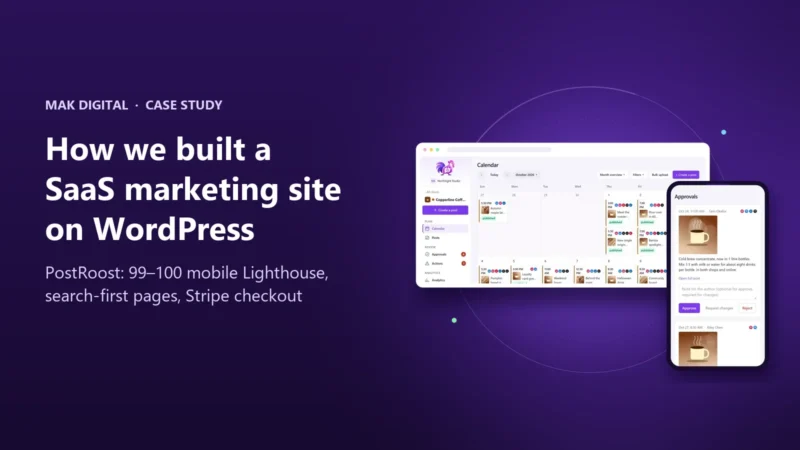
How We Built a SaaS Marketing Site on WordPress
The decisions behind the PostRoost marketing site: why it is separate from the app, how the theme stays fast, how search intent…
Read More: How We Built a SaaS Marketing Site on WordPressSmart home shoppers rarely start from a product. They start from the ecosystem they already own and ask whether a lock, camera or thermostat will work with it, needs a hub, or carries a monthly fee. MAK Digital builds smart home SEO around those questions: collections organized by ecosystem and protocol, product pages that state compatibility plainly, and a catalog that survives every new hardware generation.
15
Fifteen years of building, migrating, and growing online stores for B2B and B2C brands.
30+
SEO, AI search, paid media, design, and development experts under one roof.
USA
A US-based core team you talk to directly, backed by vetted specialists worldwide.
4.9
Average score across 650+ verified client reviews.
What we work on
A connected-device catalog is a web of dependencies: bulbs that need a bridge, cameras with optional cloud plans, switches that need a neutral wire, sensors that only talk Zigbee. Our eCommerce SEO work turns those dependencies into pages and data that match how smart home buyers search, and it sits alongside our broader electronics SEO practice.
Landing pages for Works with Alexa, Google Home, Apple Home and SmartThings, plus Matter, Thread, Zigbee and Z-Wave, built only where the catalog has enough certified products to fill them.
Templates that answer hub, app, subscription, storage, wiring and Wi-Fi band questions above the fold, with spec and comparison tables in HTML rather than images.
A decision for every retired doorbell, camera or thermostat: redirect to the successor, keep it as an owner support page, or consolidate it, with internal links and feeds updated to match.
Product and ProductGroup markup with GTIN, MPN, brand and offers, and feed titles that carry model, generation and key compatibility, with item_group_id for color and pack-size variants.
Pairing guides, troubleshooting pages and "which one do I need" comparisons on the store domain, linked to mounts, chimes, batteries, bridges and expansion sensors.
One consistent statement of Matter support, ecosystem certification and subscription terms per product, repeated across the product page, help article and feed, so AI Overviews and assistants have no conflicting versions to quote.
A separate track for businesses that install whole-home automation, motorized shades and networking: Business Profile, service-area pages and project galleries.
Search behavior
Most smart home purchases begin with a constraint the buyer already has. Someone with an iPhone and a HomePod looks for a video doorbell that works with Apple Home. A household built around Echo speakers wants smart plugs that pair through the Alexa app. A renter needs a lock that fits over the existing deadbolt. The searches carry that constraint in the query: "smart lock that works with HomeKit", "matter smart plug", "video doorbell no subscription", "smart switch no neutral wire", "thermostat that works without a c wire".
Research is spread across review publishers, YouTube installs, Reddit threads and, more and more, AI assistants. The purchase then happens on a brand store, a specialty retailer, Amazon or a big-box chain. A smart home SEO plan has to decide which of these questions the store's own pages should answer best, and build those pages first.
Site structure
A smart home catalog sorted only by device type (cameras, locks, lighting) hides the attribute buyers search for first. We add a second layer of collections built around ecosystems and radio protocols, and decide which of them deserve to be indexed.
Each ecosystem collection lists the devices that genuinely support that platform, with a short explanation of how pairing works there: through the Alexa or Google Home app, by scanning a setup code in the Apple Home app, or through a manufacturer bridge. Where a product only works with an ecosystem through a hub, the collection says so next to the product rather than leaving it to the product page.
Matter lets one certified device be controlled from several ecosystems, and it runs over Wi-Fi, Ethernet or Thread. Thread devices need a Thread border router in the home, which is often a smart speaker, streaming box or hub the buyer already owns. Zigbee and Z-Wave devices need a compatible hub. A protocol collection explains these requirements in plain terms and links to the bridges and hubs the store sells, so the page answers "will this work in my house" before the shopper leaves to ask a forum.
Ecosystem, protocol, power source, color and pack size filters can multiply into thousands of URLs. We index a small set of combinations shoppers search, such as Matter smart plugs or battery video doorbells that work with Google Home, and keep the rest crawlable but out of the index. Our guide to faceted navigation SEO explains the method.
Product pages
Smart home product pages lose sales when the answer to "will this work for me" is buried in a PDF manual or a support article on another domain. The template we build puts the dependency facts near the price and the add-to-cart button.
Resolution, field of view, battery type, lock cylinder fit and dimensions belong in an HTML spec table, not an image. A short comparison table against the previous generation or the next model up answers the questions owners ask most often when deciding whether to upgrade. Our product page SEO guide covers the wider template.
Genuine customer questions about door thickness, chime compatibility or HomeKit pairing are some of the most specific text a smart home page can carry. We help set up moderated Q&A and review collection so that text appears on the page itself.
Pairing walkthroughs, reset steps and "camera offline" fixes often sit on a separate help-desk subdomain that the store never links to. Where the support platform allows it, we bring those articles onto the store domain, or at least make them crawlable and link them both ways with the products they cover. A doorbell setup guide can then point to the chime kit, angled mount or bridge the owner needs next, and a "which one do I need" guide can separate the wired and battery models, or the Wi-Fi and Thread versions, before the shopper picks the wrong one.
Catalog change
Smart home hardware turns over quickly. Doorbells, cameras, thermostats and hubs gain a new generation, a new chipset or Matter support through firmware, and the old model either disappears or lingers in stock. Each change creates URL decisions, and getting them wrong can cost a store the rankings it built for the earlier model.
When a successor replaces a model completely, the old product URL can redirect to the new one, carrying its links and history. When both are sold side by side, they keep separate pages with clear "compared with the previous generation" sections and internal links in both directions. Product data should show the change too: an old model can be marked as discontinued in structured data before the page is retired.
Owners of an older doorbell still search its model name for reset steps, compatible chimes and replacement batteries. A slim support page for the legacy model keeps that traffic on the brand's domain and points to accessories that still fit and to the upgrade path.
Color options, two-packs, starter kits with a bridge and camera bundles often produce near-identical pages that compete with each other. We group true variants under one product, give bundles their own page only when people search for the bundle, and point the rest to the main product with canonical tags. We map these redirects and canonicals before each hardware launch, using the approach in our guide to managing redirects the right way.
AI search
Compatibility questions suit AI answers well: "does this camera work with Google Home", "which smart thermostat works with a heat pump", "best Matter smart plug for Apple Home". AI Overviews and assistants such as ChatGPT build those answers from pages that state the facts plainly and agree with each other. When a brand's product page, help article, feed and marketplace listing disagree about Matter support or subscription requirements, the answer an assistant gives can be wrong or can come from a reseller.
This sits inside our generative engine optimization service. AI search optimization is included in MAK SEO plans from $2,000/month.
Installers and integrators
Some smart home businesses do not sell devices online at all. Integrators who design whole-home automation, motorized shades, lighting control, home theatre and networking win work through local searches such as "smart home installer near me" or "home automation company" plus a city name. Their SEO looks more like a contractor's than a retailer's.
We keep this intent separate from the device-retail pages so neither confuses the other, and handle it through our local SEO service.
Product data
Smart home product data has to agree in three places: the visible page, the structured data and the Merchant Center feed. These are the fields we check first on a connected-device catalog, following Google's product structured data and Merchant Center specifications.
| Field | On the product page | In structured data | In the Merchant Center feed |
|---|---|---|---|
| Model and generation | In the H1 and spec table, e.g. "Video Doorbell (3rd Gen)" | name, model, mpn | title starts with brand, device type, model and generation |
| Identifiers | Model number visible in specs | gtin, mpn, brand | gtin, mpn, brand that match the packaging |
| Compatibility | Sentence plus spec row listing certified ecosystems | additionalProperty where useful; FAQ for questions | Ecosystems in title or description where space allows, product_detail for specs |
| Variants | Color or pack size selector | ProductGroup with hasVariant and variesBy | item_group_id with color or size |
| Bundles and multi-packs | Contents list, e.g. bridge plus two bulbs | Separate Product; the manufacturer's bundle GTIN, or the main item's GTIN for a store-built bundle | is_bundle for kits, multipack for packs of the same item |
| Subscription | Plan terms near the price | Offer for the device price only | Description states which features need a plan |
| Availability | In stock, preorder or discontinued | availability, including Discontinued | in_stock, out_of_stock or preorder kept in sync; retired models removed from the feed |
Go deeper
Related reading from the MAK Digital blog.
Competition
Broad smart home terms such as "best video doorbell" tend to go to marketplaces, big-box chains and review publishers. A brand or specialty store wins where those pages are thin: exact models, ecosystem detail and what happens after the box is opened.
Searches for a brand's own model names should land on the brand's page, not a reseller listing. That needs complete model pages, matching feed titles and a clear official-store signal.
"Zigbee motion sensor for SmartThings" or "Thread smart blinds for Apple Home" are too specific for a marketplace category page. A protocol collection with real explanations can rank for them.
Setup guides, reset steps and accessory pages bring owners back to the brand's domain, where the next camera, sensor or chime is one link away.
Holiday gifting and major retail sale events concentrate demand for speakers, cameras and starter kits. Collection pages and feeds should be ready weeks before, and new-generation pages before launch day.
Trust and standards
Connected-device buyers worry about privacy, hidden fees and devices that stop working after an update. These are the standards we check when we audit a smart home store.
MAK Digital was founded in 2012 and works with 30+ in-house specialists across 800+ projects. We are a Google Premier Partner and a BigCommerce Elite Partner, and we work on Shopify, BigCommerce and other platforms. For a smart home catalog we fix product data and URL rules before writing new content, because compatibility pages are only useful when the products behind them are accurate.
A free SEO audit of indexation, faceted URLs, duplicate variants, retired models, product markup, feed errors and where help content lives.
Keyword research split into ecosystem, protocol, feature, model and generation, setup and installer intent, then mapped to existing or planned pages.
Collection architecture, filter indexing rules, variant grouping, generation redirects and schema aligned with the feed. On Shopify or BigCommerce we work within each platform's variant and URL rules.
Product template updates, ecosystem collection copy, setup guides, upgrade comparisons and FAQ answers written so people and AI assistants read the same facts.
Reporting on rankings, clicks and revenue split by ecosystem collection, product, legacy support and setup pages, plus checks on how AI answers describe each product's compatibility, with priorities reset before each hardware launch and the holiday season.
Reviews from the businesses whose websites and search programs we run.
Marc Frankel
CEO, Longislandwatch.com
★★★★★
“The MakDigital crew whipped up a gorgeous website for me, and they went the extra mile! The bespoke site they churned out knocked my socks off and exceeded all my expectations.”
Kirsten Logan
Clava.com
★★★★★
“Mary is the person you need to know and work with if you have a Volusion site. She is incredibly knowledgeable about all things Volusion and we couldn't have set up our store the way we wanted to without her, and it looks great! Thank you Mary and Mak Digital.”
Anthony DiCicco
ProDryers
★★★★★
“MAK is literally my go-to developer for Volusion and BigCommerce. I have used Mary many times and will continue to do so. I have not found a more reliable and knowledgeable person to handle all of our technical issues with both platforms. I made the mistake of going with a company that I thought was bigger and better. I ended up having to hire MAK to fix all of their mistakes that would have cost me hundreds of thousands in lost sales. It's important to have a full understanding of the database structures and business rules of each platform. MAK really understands the fine details behind these platforms. MAK has truly earned my trust for life.”
Request a free audit of your ecosystem collections, product pages, retired models, product data and feed, with fixes listed in priority order.
Questions smart home brands, online retailers and installers ask about search.
Yes, when the catalog has enough products that are actually certified for each platform. Shoppers search by the ecosystem they already own, so a Works with Apple Home collection matches that query better than a general lighting category. Each page should explain how pairing works on that platform and flag products that need a bridge. Filter combinations beyond those core collections usually stay out of the index.
Matter creates searches that cross brands, such as "matter smart plug" or "matter lock for Google Home", because one certified device can join several ecosystems. Add Matter, Thread and Wi-Fi details to product pages, data and collections, explain when a Thread border router is needed, and only claim Matter for products that are certified. If support arrives through a firmware update, say which version added it.
If the old model is no longer sold and the new one is its direct replacement, redirect the old URL to the new product and update internal links and feeds. If both are sold, keep both pages and link them with a comparison. In either case keep a support page for owners of the older model so reset, battery and accessory searches still reach your domain. Remove the retired model from the Merchant Center feed at the same time.
Often, yes. Pairing guides and troubleshooting articles attract searches from owners and can earn links from forum threads, and on the store domain they can link straight to the chime, mount or bridge someone needs next. If a help-desk platform must host them, make sure they are crawlable and linked in both directions with the product pages they support.
State them plainly near the price: which features work without a plan, which need one, and where video or data is stored. "Does it need a subscription" is one of the most common pre-purchase smart home questions, so a clear answer helps both conversion and search. Privacy statements should match how the product really handles data, since the FTC treats misleading privacy claims as deceptive. This is a general note, not legal advice.
Not on broad head terms in most cases, and chasing them rarely pays. Brands win on their own model names, on long-tail ecosystem and protocol queries, on upgrade comparisons and on setup content that marketplace listings do not provide. Complete product schema and a clean Merchant Center feed help the brand's own listing show for its products, which our Google Shopping management team supports.
Product markup with offers, price, availability, GTIN, MPN and brand comes first, following Google's product structured data guidelines. Add ProductGroup for color and pack-size variants, review markup only for genuine customer reviews, BreadcrumbList for the collection path and Organization for the brand. Compatibility details can go in visible spec rows and additionalProperty, but the markup must match what the page shows. For how AI answers use the same facts, see our answer engine optimization service.
Yes. Installers and integrators are local service businesses: their results depend on a Google Business Profile, service-area pages, project galleries and reviews. Device retailers sell nationally, so their work is collections, product pages and feeds. A business that does both should keep the two intents on separate pages, so "smart home installer near me" lands on a service page and "Matter smart plug" lands on a collection.
From the eCommerce Experts
The decisions behind the PostRoost marketing site: why it is separate from the app, how the theme stays fast, how search intent…
Read More: How We Built a SaaS Marketing Site on WordPressWinning now means treating discovery as a product data problem, not only a rankings problem. AI SEO for eCommerce is the discipline…
Read More: AI SEO for eCommerce: The Complete 2026 Strategy for Online StoresOnline shopping is starting to move from “type a query, scan a product grid, open ten tabs” toward a more delegated path:…
Read More: Agentic Commerce Explained: How AI Agents Will Buy From Your StoreTwice a month: what changed in Google and AI search, what it means for your store, and exactly what to do about it. Written by the people who build and rank stores for a living.
First issue lands within two weeks. Check your inbox for a hello from us in the meantime.