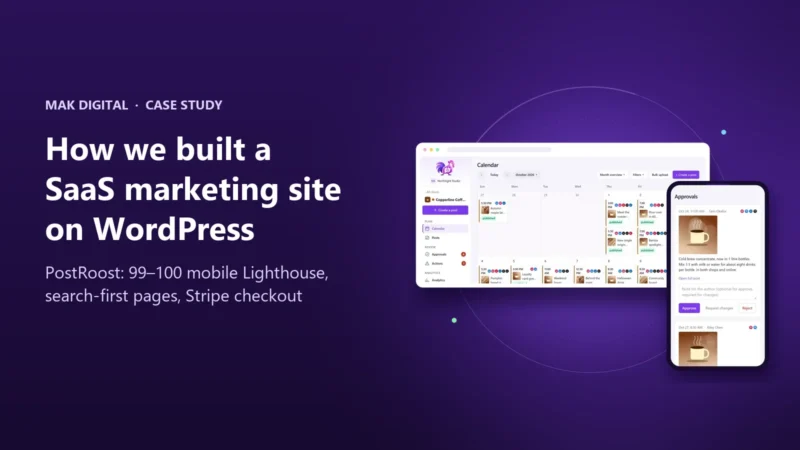
How We Built a SaaS Marketing Site on WordPress
The decisions behind the PostRoost marketing site: why it is separate from the app, how the theme stays fast, how search intent…
Read More: How We Built a SaaS Marketing Site on WordPressIf your sale starts with a phone call, a quote request or a demo booking, rankings and traffic are only the middle of the story. MAK Digital's lead generation SEO finds the searches your buyers type when they are ready to talk, builds the service and location pages that answer them, removes friction from forms and click-to-call, and tracks each inquiry back to the page that produced it.
15
Fifteen years of building, migrating, and growing online stores for B2B and B2C brands.
30+
SEO, AI search, paid media, design, and development experts under one roof.
USA
A US-based core team you talk to directly, backed by vetted specialists worldwide.
4.9
Average score across 650+ verified client reviews.
What the work covers
SEO lead generation is a chain: a buyer searches, finds a page, trusts it, and contacts you. A weak link anywhere in that chain loses the inquiry, so our lead generation SEO services cover each step rather than stopping at rankings.
We separate searches that tend to produce inquiries (service plus location, "cost of", "company for", "alternative to", problem queries) from searches that mostly produce readers, and give each lead-producing query one owning page. Our SEO keyword research method sits underneath.
One page per service a buyer asks for by name, covering scope, process, who it suits and what happens after the form is sent. Location pages only where you genuinely serve an area.
Field count and order, button wording, mobile click-to-call, quote and demo flows, and thank-you pages that set expectations. Fixing pages that already rank is often the quickest route to more organic leads.
GA4 key events for forms and calls, call tracking that keeps NAP consistent, and hidden fields that pass the landing page and source into your CRM.
Crawlable service and location sections, mobile speed on form pages, Service and FAQPage schema, and thank-you and parameter URLs kept out of the index. It starts with a website audit.
Comparison pages, pricing explainers that describe cost drivers without a public rate card, and buyer checklists that route readers to the matching service page.
Answer-first service copy, consistent entity details and FAQ structure so Google AI Overviews and assistants can describe and cite your business. AI search optimization is included in MAK Digital SEO plans from $2,000/month.
Shared keyword lists, landing pages and lead-quality feedback between organic and paid search, so the two channels stop bidding against and duplicating each other. We work with your PPC marketing team, or ours.
Definition and fit
Lead generation SEO is search optimization for companies whose conversion is a conversation rather than a checkout: a booked call, a quote request, a demo booking, an RFQ or a consultation request that sales can work. In eCommerce SEO the order confirmation closes the loop inside the store. In lead generation the sale happens later, in a CRM, on the phone or in a meeting, so the program has to follow the lead out of the website to judge whether a page is working.
The page types change too: service, solution, industry, location and comparison pages instead of products and categories, with Service, Organization or LocalBusiness and FAQPage schema instead of Product and Offer. The core SEO services still apply; the emphasis and the measurement change.
It fits when one extra qualified inquiry a month is worth real money, when sales can tell good leads from poor ones, and when we can see what happens to an inquiry after it arrives. It fits poorly if every sale completes online without contact, or if nobody follows up web inquiries quickly enough to win them.
Keyword strategy
Many lead-gen websites rank for plenty of terms and still receive few inquiries, because the traffic comes from definitions, career questions and DIY how-tos. The fix is to separate the searches that produce leads from the ones that produce readers, then give the lead-producing searches the strongest pages and the most internal links.
Buyers often search the problem before the service: "furnace short cycling", "conveyor belt tracking issues", "CRM not syncing with ERP". A page that diagnoses the problem and explains when to call a specialist turns research into an inquiry.
The service name plus "company", "contractor", "near me", a city or "for manufacturers" carries the clearest intent. These belong on dedicated service and location pages, not on a blog post that mentions the service.
"In-house vs outsourced", "alternative to" and "how much does commercial roof coating cost" come from buyers building a shortlist. A fair comparison, or a page that explains cost drivers and what a quote includes, answers honestly even if you never publish prices.
We test each target against reality: if Search Console shows a page ranking and the CRM shows no leads from it, the query or the page needs rethinking.
Conversion
Lead generation SEO pages have two jobs: rank for a buyer-intent search and persuade that buyer to make contact. Both depend on answering the questions a buyer would otherwise ask on the first sales call.
Thin clones, such as dozens of city pages with only the town name changed, are a common reason lead-gen sites stall. We build one substantial page per service and per real service area, tied to the work on our local SEO marketing page and a well-kept Google Business Profile.
Put your process, credentials you actually hold, service areas and real case studies beside the call to action. Invented reviews create risk under FTC endorsement rules and with professional regulators.
We agree with sales which fields qualify a lead (service, location, timeline, company size) and make the rest optional. Contractors and practices need a tappable phone number in the mobile header; B2B and SaaS buyers respond to a short RFQ or demo form that says what happens next.
Spam protection should stop bots without blocking genuine buyers. Where follow-up is by call or text, consent wording matters under the US Telephone Consumer Protection Act; we flag forms for review by your own counsel rather than writing legal terms.
Measurement
If a form submission reaches your inbox without its landing page, nobody can say which SEO work earned the lead.
Each form submit, click-to-call tap and booking becomes a GA4 key event, fired on confirmed submission rather than a button click. Dynamic number insertion shows a tracking number to website visitors while your Google Business Profile and citations keep the main number, so NAP consistency holds.
Hidden fields and UTM parameters carry the first landing page, channel and referrer into HubSpot, Salesforce or your CRM. Offline conversion import can send closed deals back to Google Ads, which also sharpens the data we use for SEO targeting.
Sales marks organic inquiries as qualified, unqualified or spam, so reports show which pages bring MQLs and SQLs. One honest limit: Search Console does not tie queries to individual visitors, so query-level attribution is an estimate. The reliable unit is the page.
Content and AI search
Lead-gen content should shorten the sales conversation. Before contacting you, a buyer wants to know whether you handle their situation, roughly what it involves and how you compare with their shortlist.
Comparison pages, pricing explainers, buyer checklists and "questions to ask a provider" guides usually earn fewer visits than broad guides, but the visitors they do earn are closer to choosing a provider. Educational posts still help when each links clearly to the service page that solves its problem; our content marketing team plans them as paths.
Where several people approve a purchase, give each what they need: specifications for the technical evaluator, implementation steps for the project owner, procurement answers for finance. This pairs with our B2B SEO services.
Google AI Overviews and assistants such as ChatGPT now answer many early questions that used to send visitors to a lead-gen blog, and buyers then ask "which companies offer this near me". To be named, service pages need plain statements of what you do, where and for whom, consistent business details and FAQ answers. See answer engine optimization and our AI visibility check.
Stores that take quotes
Many B2B online stores are half store, half lead generation site. Small orders go through checkout; larger buyers want a quote, net terms, a wholesale account, samples or a local dealer. Those paths are often an afterthought: a generic contact form or a "call for pricing" label with no form at all.
This is where MAK Digital's eCommerce background meets lead generation SEO. As a BigCommerce Elite Partner working on BigCommerce, Shopify and other platforms, we treat quote and account flows as part of the store's SEO. For storefront design, see our B2B web design services.
Go deeper
Related reading from the MAK Digital blog.
SEO and PPC together
For inquiry-driven businesses, the question is rarely SEO or paid search. It is how to use each so the phone keeps ringing while organic lead flow builds.
New service and location pages take time to earn rankings. Search ads on the same terms keep inquiries arriving in the meantime, and can be reduced on terms where organic pages start winning the clicks.
Your Google Ads search terms report shows exact phrases that already produced calls and forms. Those phrases are strong candidates for dedicated organic pages, because their lead intent is proven rather than guessed.
Paid and organic visitors land on the same service pages where possible, so form and CTA improvements raise lead rates on both channels.
When sales marks inquiries as qualified or not, both channels learn from it: ads bid on what closes, and SEO prioritizes the pages and topics that bring buyers rather than tire-kickers.
Technical standards
The technical checks we apply to every lead generation site, with most weight on the pages that carry forms and phone numbers.
MAK Digital was founded in 2012 and has 30+ in-house specialists and 800+ projects behind it. We do not promise lead counts: they depend on your market, competition and how quickly your team responds.
We review rankings, technical health, page speed and indexation, then follow your lead path as a buyer would: search, landing page, form or call, confirmation and what your team receives. Gaps in tracking are listed alongside SEO issues.
Every lead-producing search is assigned to one page, existing or new, with the traffic-only searches noted separately. You see which pages to improve first and which new pages are worth building.
We start with pages that already get organic visits but few inquiries, improving copy, proof, forms and click-to-call, then add new service, location and comparison pages from the map.
GA4 key events, call tracking, hidden source fields and CRM mapping are configured and tested with real submissions, so the first monthly report already shows leads by landing page.
Monthly reports show organic leads by landing page, calls and forms, lead quality feedback from sales, and rankings and traffic as supporting context. The next month's work follows from what the leads show. To start, contact MAK Digital.
Reviews from the businesses whose websites and search programs we run.
John
Pool & Hot Tub Depot
★★★★★
“Working with this team has been an absolute pleasure! Their dedication to creating successful e-commerce stores is unmatched. We collaborated seamlessly, and their expertise helped us achieve outstanding results. Our online store has seen tremendous growth and success thanks to their guidance and support. Highly recommended!”
The Barn Door Hardware Store
★★★★★
“Marina really tuned into our wishlist and crafted a plan that nailed all our requirements. Her communication throughout the entire process was just top-notch. I'd totally vouch for them and plan on sticking with them for my future marketing adventures!”
Arman
Glowback, glowbackledstore.com
★★★★★
“Launching and managing an e-commerce store can be daunting, but this team made it simple and stress-free. Their comprehensive approach, from website design to marketing strategies, ensured a seamless and engaging customer experience. Our store's performance surpassed our wildest expectations, thanks to their expertise and dedication. Working with them was truly a game-changer for our business.”
Tell us how your leads arrive today. We will review which pages and searches can bring qualified inquiries, what is blocking them, and whether your tracking can show where each lead came from.
Questions inquiry-driven businesses ask before investing in SEO for lead generation.
By ranking your service, location and comparison pages for the searches buyers type when they are ready to contact a provider, then converting those visitors with clear calls to action, short forms and click-to-call. Tracking each inquiry to its landing page shows which pages earn leads, so effort goes where inquiries come from.
The conversion is an inquiry, not a checkout, so measurement continues in your CRM. Lead generation sites rely on service, industry and location pages with Service and FAQPage schema; stores rely on category and product pages. If your sales complete online without any contact, an eCommerce SEO program fits better.
It depends on your site's history, how competitive your service and area are, and your sales cycle. Conversion and tracking fixes on pages that already rank can show an effect sooner than new pages, which need time to earn rankings. In B2B a lead may take months to close, so we report leads and lead quality as well as revenue.
Often, yes, especially when a new service or location page has not yet earned rankings and the sales team needs calls this month. Ads fill that gap, and the phrases that produce qualified leads in paid search become organic targets. Once an organic page wins the clicks for a term, spend on that term is worth reviewing rather than cutting blindly, because the two results together can still win more inquiries.
We capture each inquiry's landing page and source in GA4 and your CRM, ask sales to mark leads as qualified or not, and combine that with the Search Console queries each page ranks for. Search Console does not link queries to individual visitors, so keyword-level attribution is an estimate; page-level attribution is reliable.
Start with an audit. Many sites have pages that already attract buyers but lose them to long forms, buried phone numbers or slow mobile loading. Fixing those usually comes before new pages, which we add where the intent map shows a lead-producing search with no page to own it.
Yes. B2B and wholesale stores often win their largest orders through request-a-quote forms, wholesale account applications, sample requests and dealer locators. We optimize and track those paths alongside product and category SEO, so a buyer searching for a wholesale supplier lands on a page that invites a quote instead of a cart.
Google AI Overviews, ChatGPT and similar assistants answer many early research questions directly, so broad informational posts can send fewer visitors than they once did. Buyers still need a provider, and assistants suggest companies when asked who offers a service in an area or for an industry. To be one of the companies named, your service pages, Google Business Profile and directory listings need to describe the same services, areas and client types in the same words, and your pages need to answer the qualifying questions a buyer asks before requesting a quote.
From the eCommerce Experts
The decisions behind the PostRoost marketing site: why it is separate from the app, how the theme stays fast, how search intent…
Read More: How We Built a SaaS Marketing Site on WordPressWinning now means treating discovery as a product data problem, not only a rankings problem. AI SEO for eCommerce is the discipline…
Read More: AI SEO for eCommerce: The Complete 2026 Strategy for Online StoresOnline shopping is starting to move from “type a query, scan a product grid, open ten tabs” toward a more delegated path:…
Read More: Agentic Commerce Explained: How AI Agents Will Buy From Your StoreTwice a month: what changed in Google and AI search, what it means for your store, and exactly what to do about it. Written by the people who build and rank stores for a living.
First issue lands within two weeks. Check your inbox for a hello from us in the meantime.