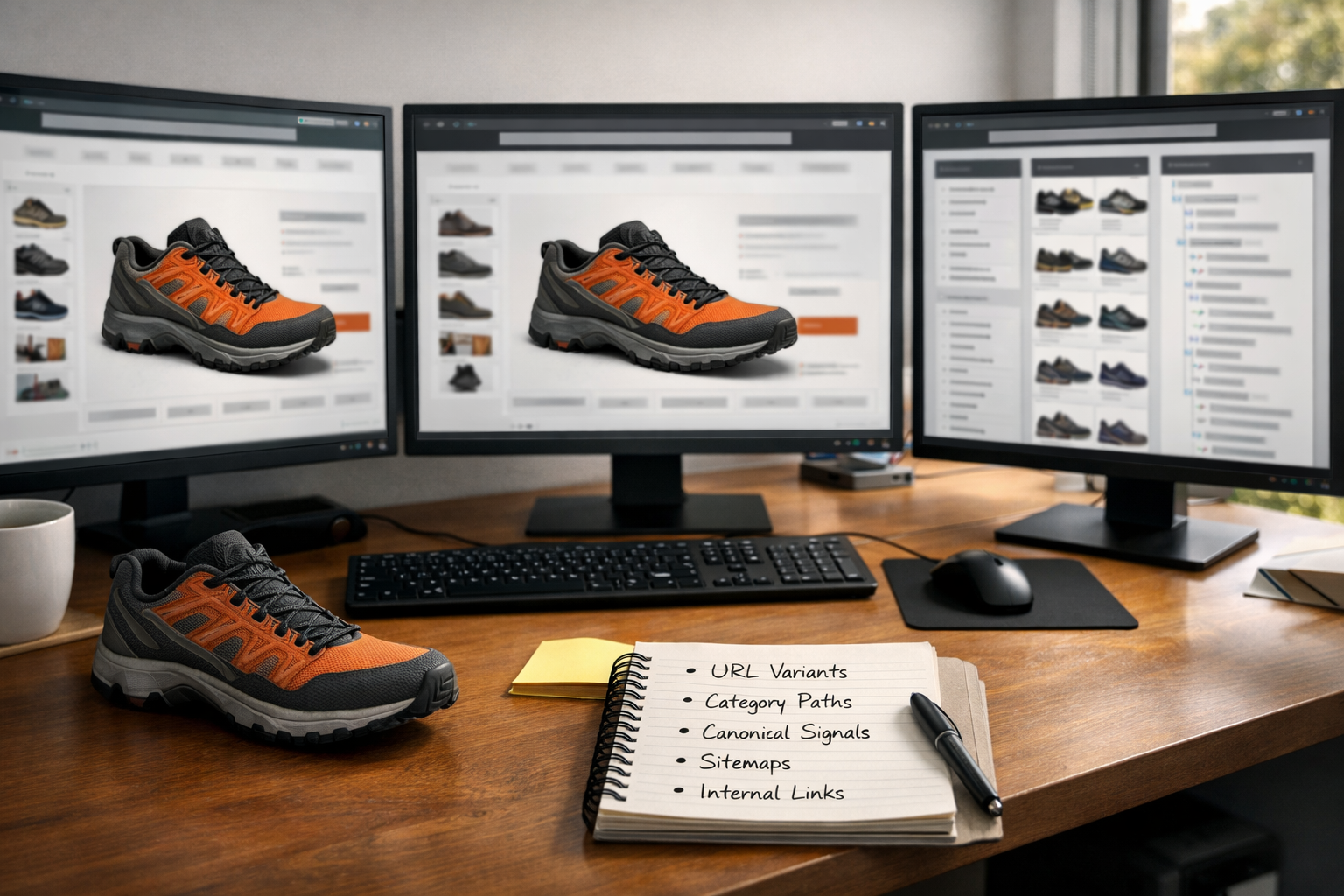
Magento Layered Navigation SEO: Fixing the Filter Crawl Trap

Magento’s layered navigation is built for shoppers: it lets them narrow a category by attributes such as color, size, brand, price, rating, availability, sorting, and pagination. The SEO problem begins when those refinements create crawlable URLs like /women/shoes.html?color=black, /women/shoes.html?brand=nike&size=8, or /men/jackets.html?price=100-200&product_list_order=price. One or two useful filters can quickly turn into thousands of near-duplicate paths when attributes stack together.
That is the core Magento layered navigation SEO risk: a category that should send clear relevance signals can be diluted across many URLs showing substantially the same product set, title pattern, meta description, and internal links. Search engines may spend crawl activity on low-value combinations instead of important categories, products, and curated landing pages. The result is not simply “duplicate content”; it is index bloat, weaker category focus, and a crawl trap where bots keep discovering more parameter combinations than the store can make useful.
The fix is not to remove every filter from search engines. Some filtered pages, such as a strong brand-plus-category page or a high-demand attribute landing page, may deserve indexation if they have search demand, stable inventory, unique copy, and deliberate internal links. Weak combinations, such as sort orders, temporary price bands, multi-select color stacks, or paginated parameter variants, usually need control.
This playbook focuses on four levers: crawl control, which limits what bots can discover; indexation, which decides what may appear in search results; canonicalization, which consolidates duplicate signals toward a preferred URL; and internal linking, which tells search engines which category and filter paths matter. Good Magento faceted navigation SEO preserves shopper refinement while exposing a smaller, intentional set of URLs for search.
How Magento Filter URLs Create a Crawl Trap
Start with the rendered links in a category sidebar: every selected facet, price bucket, sort choice, and page number can be output as a distinct href. A color selector filters the product set by one attribute value, a price selector groups products into ranges, sorting changes the order of the same listing, and pagination splits results across pages. Each control may be useful for shoppers, but each can also create another URL that a crawler can discover.

For example, a single category might generate paths such as /women/shoes.html?color=black, /women/shoes.html?size=8, /women/shoes.html?brand=nike, /women/shoes.html?price=100-200, and /women/shoes.html?product_list_order=price. When filters stack, the URL becomes more specific: /women/shoes.html?color=black&size=8&brand=nike&price=100-200. If pagination and sorting are appended, that same filtered set can become /women/shoes.html?color=black&size=8&brand=nike&price=100-200&product_list_order=price&p=2.
The arithmetic is the trap. Ten colors, eight sizes, twenty brands, five price ranges, four sort orders, and ten paginated result pages can produce 320,000 possible URL variants from one category before adding stock status, rating, material, width, or multi-select filters. Across dozens or hundreds of categories, Magento filter URLs SEO problems can move from a few messy parameters to a sitewide pattern of excessive crawlable URLs.
Not every generated URL has the same value. A clean page like /women/shoes.html?brand=nike may map to a real search pattern if it has enough products, stable inventory, unique copy, and intentional internal links. A URL like /women/shoes.html?color=black&color=white&size=8&price=100-200&product_list_order=name&p=7 is usually a weak search candidate because it narrows the set without adding a distinct search intent or useful content.
Canonical tags can help consolidate duplicate signals toward a preferred category or curated filter page, but they do not stop Googlebot from crawling URLs it can still find through links. That is why a Magento crawl trap is not solved by canonicalization alone: the crawler may continue spending time on parameter combinations even if many of those pages point back to the same canonical destination.
How to Find a Magento Layered Navigation Crawl Trap
Start with an ecommerce SEO site audit approach by separating “many useful URLs” from “many discoverable variants.” In a crawl export, group URLs by template and parameter keys: category paths, filtered category paths, sort URLs, price ranges, pagination, search-result URLs, and session or tracking parameters. A healthy Magento layered navigation SEO footprint usually shows a controlled set of category pages plus a smaller set of intentional filtered landing pages. A crawl trap shows the opposite: parameterized URLs outnumber categories and products, and the same category appears under dozens or hundreds of URL combinations.
In Google Search Console, look for patterns rather than single examples. The warning signs are clusters of filtered URLs under statuses such as Crawled – currently not indexed, Duplicate without user-selected canonical, and Alternate page with proper canonical. Those labels mean different things: “crawled but not indexed” suggests Googlebot spent time on a URL without selecting it for the index; “duplicate” suggests Google found similar content but no clear canonical signal; “alternate with canonical” suggests consolidation is working, but crawl demand may still be high. Large clusters of these statuses tied to color=, size=, price=, product_list_order=, or p= are a practical index bloat signal.
Server logs show whether the issue is consuming Magento crawl budget. Filter log requests by Googlebot, then compare hits to core categories, products, and filtered URLs. If Googlebot repeatedly requests deep combinations such as ?brand=nike&color=black&size=8&p=6 while important product or category URLs receive fewer visits, the problem is not just indexation; it is crawl allocation.
Next, trace how crawlers find the URLs. In a crawler, inspect inlinks to parameterized pages from category templates, sidebar filters, sort controls, pagination links, breadcrumbs, product grids, XML sitemaps, and HTML sitemaps. A weak signal is one accidental URL found once. A strong crawl-trap signal is sitewide internal linking that exposes every selectable filter state as a normal anchor link.
Finish by sampling the pages themselves. Compare titles, meta descriptions, headings, product counts, canonical targets, and rendered content for a clean category, a valuable one-filter page, and a multi-filter variant. If the multi-filter URLs have thin or duplicated metadata, unstable product sets, no unique copy, and no independent search intent, they belong in the control group for later remediation rather than the indexable landing-page set.
Which Magento Filter Pages Are Worth Indexing?
The pages that survive that sampling should earn indexation because they can act like intentional landing pages, not merely because Magento can generate them. A good candidate is a filtered category page where the filter changes the search intent in a meaningful way: /running-shoes/nike/ or a clean equivalent for “Nike running shoes” is different from the parent running-shoes category, while ?brand=nike&color=black&size=8&price=50-75 is usually a narrow shopping state rather than a durable search page.
Use four gates before allowing a filter URL into the indexable set. First, look for independent demand: category-plus-brand, category-plus-product-type, and some high-intent attribute combinations can match how people search, while sort orders, page-size selectors, and most price ranges rarely deserve standalone landing pages. Second, require merchandising value: the page should support a product set you actually want to promote, not a temporary slice created by one shopper’s refinement path.
Third, require enough stable inventory. If a filter routinely returns only one or two items, goes empty after seasonal changes, or depends on volatile stock, it will be hard to maintain as a useful landing page. A page for “black leather handbags” may be worth building if it consistently contains a strong product range; color filters for obscure colors or low-stock variants usually belong outside the indexable set.
Fourth, require unique page signals. An indexable filtered page should be able to carry its own title tag, H1, meta description, introductory copy, clean URL, and internal links that describe the refined intent. If the page uses the same title pattern, same copy, same canonical target, and nearly the same product grid as the parent category, it is not adding enough distinction to justify indexation.
A practical Magento layered navigation SEO rule is to curate, not liberate. Build a short allow-list of valuable filtered category pages, such as brand filters inside major categories or attributes with proven demand, and treat the rest as control candidates. The takeaway is simple: index filters that can be marketed, maintained, and internally linked like real landing pages; control filter combinations that only help shoppers narrow results during a session.
Canonical, Noindex, Robots.txt, or Blocking Links: What to Use When
Once the allow-list is small, the control layer becomes a routing problem: each remaining URL pattern needs one clear instruction for ranking, indexing, crawling, and link discovery. Treat these tools as different levers, not interchangeable fixes.
| URL pattern | Best-fit control | What changes | Tradeoff |
|---|---|---|---|
Curated filtered landing page, such as /running-shoes/nike/ | Self-canonical, indexable, internally linked | The page is treated as a destination with its own title, copy, product set, and links. | It must be maintained like a real category page, not left as a raw filter state. |
Duplicate or near-duplicate filter, such as ?color=black when the parent category already satisfies the intent | Canonical to the parent category or stronger curated page | The filter can still be crawled, but signals are consolidated toward the preferred URL. | Crawlers may still spend time fetching the duplicate URL if links to it remain open. |
| Useful for shoppers but weak for search, such as narrow size-plus-price combinations | meta robotsnoindex,follow while crawl access remains open | The page can be discovered and its links can be followed, but it is not meant to stay in the index. | The directive has to be seen on the page, so blocking the same URL in robots.txt defeats the purpose. |
| Infinite or utility patterns, such as sort orders, page-size controls, tracking parameters, or endlessly stackable refinements | Robots.txt disallow, link removal, AJAX/non-link controls, or platform-level parameter suppression | Discovery and crawl demand are reduced before bots spend time on low-value combinations. | Robots.txt prevents crawling, but it also prevents crawlers from seeing canonical or noindex directives on those blocked URLs. |
Use canonical tags when the page is a duplicate variant of a stronger URL and you still need the variant accessible to users. For example, /women/shoes.html?color=black might point its canonical target to /women/shoes.html if the black filter does not deserve its own landing page. A curated page, by contrast, should normally self-canonicalize so it can accumulate its own relevance signals.
Use meta robots noindex when the URL may be crawled but should not appear in search results. This is often appropriate for filter combinations that help shopping behavior but create thin or unstable search pages. The practical distinction is important: noindex is an indexation control, not a crawl prevention tool.
Use robots.txt disallow for patterns where crawl prevention matters more than directive discovery. Sort parameters like ?product_list_order=price, display controls like ?product_list_limit=all, and tracking parameters are common candidates because they usually change presentation or measurement rather than search intent. Avoid the common technical SEO mistake of pairing robots.txt blocking with a plan that depends on Google seeing page-level canonical or noindex tags.
Use link controls and platform logic to stop the trap at the source. That can mean removing crawlable href links from low-value filter combinations, limiting how many facets can stack into crawlable URLs, normalizing parameter order, excluding controlled filters from XML sitemaps, or rendering some refinements through AJAX interactions that do not expose every state as a crawlable link. AJAX is not automatically safe; the key question is whether the unwanted URL states are still discoverable through links, sitemaps, scripts, or external references.
The strongest setups combine these controls: index and self-canonicalize the curated set, canonicalize close duplicates, noindex crawlable shopper-only states, and block or de-link parameter patterns that create crawl waste at scale.
A Magento-Specific Remediation Plan
Implement the control layer from the data model outward, because Magento filter behavior starts with the attributes exposed to categories. Review each product attribute that appears in layered navigation and classify it by search value: brand, product type, material, or use-case attributes can support curated landing pages when demand and inventory are strong; size, availability, price, rating, and most operational attributes are usually shopper refinements rather than indexable destinations. The practical takeaway is to expose fewer attributes as crawlable filter paths than you expose as user-facing refinements.

- Brand filters: keep them available where they create meaningful category intent, such as
/running-shoes/nike/. For priority brand-category pairs, use clean landing URLs, self-canonicals, unique titles, unique copy, and internal links from relevant category or brand hubs. - Color filters: allow selectively when color materially changes demand, such as “black leather boots.” Weak color states should remain usable for shoppers but canonicalize or noindex rather than becoming indexable pages by default.
- Size filters: treat as transactional refinements. A size URL is often unstable because inventory changes quickly, so avoid making size combinations indexable unless the store has a deliberate landing-page strategy for that query class.
- Price filters: control aggressively. Price ranges can generate many low-value URLs, especially when combined with brand, color, and size. Keep them out of sitemaps, avoid crawlable links where possible, and use noindex or blocking patterns based on whether crawlers need to see the page-level directive.
Next, normalize URL behavior. Choose one format for filter URLs, one parameter order, and one canonical target rule per pattern. If ?color=black&brand=nike and ?brand=nike&color=black both resolve, the platform or extension should collapse them into a single preferred order. Clean rewrites can help selected landing pages look intentional, but clean URLs do not make a weak filter page valuable; /women/shoes/black/nike/ can be just as duplicative as the parameter version if it has no unique purpose.
Set canonical behavior by page class, not globally. Curated filter landing pages should normally self-canonicalize. Weak one-filter variants can canonicalize to the parent category or a stronger curated page. Multi-select combinations should not self-canonicalize by default unless they have been approved as landing pages. This is a common failure point in Magento 2 layered navigation SEO projects: an extension creates attractive filter URLs while also letting every combination declare itself canonical.
Use meta robots rules as a pattern system. A practical rule set might be: index curated brand-category pages; noindex color-only pages unless approved; noindex all size, price, rating, and stock-status combinations; noindex any URL with more than one active filter; and block or de-link sort, limit, view-mode, and tracking parameters. The exact thresholds can vary, but the important implementation detail is consistency: the same URL pattern should not be indexable in one template, canonicalized in another, and blocked somewhere else.
Audit layered navigation extensions before launch or after any configuration change. Look for controls for canonical tags, meta robots, crawlable filter links, AJAX behavior, clean URL rewrites, parameter ordering, sitemap inclusion, multi-select filters, and maximum filter depth. AJAX filters do not automatically solve the problem if the same URLs remain discoverable in rendered HTML, scripts, XML sitemaps, or internal links. The safer pattern is to let shoppers refine freely while limiting which states produce crawlable anchors.
For development work, build guardrails into templates and routing logic. Do not output crawlable href links for every possible stacked refinement. Cap indexable filter depth, normalize parameter order before rendering canonicals, prevent empty-result filter URLs from being linked, and keep controlled parameter patterns out of XML sitemaps. The remediation is successful when Magento still supports the shopping journey, but search engines encounter a deliberate set of category, product, and approved filtered landing pages rather than every possible filter state.
Protect Category, Product, and Valuable Filter Landing Pages
Preserving the money pages is the constraint that keeps crawl control from becoming overblocking. Clean category URLs should remain the primary crawl routes into the catalog: /women/shoes.html should lead to products, subcategories, and approved landing pages without requiring a crawler to pass through ?color=black&size=8 or another controlled filter state.
Use XML sitemaps as an inclusion signal, not a dump of every URL Magento can generate. The sitemap should list canonical category pages, product pages, and intentionally curated filter landing pages; low-value parameter URLs, sort URLs, view-mode URLs, and stacked refinements should stay out. The practical tradeoff is simple: sitemap inclusion helps discovery for URLs you want crawled, while exclusion does not block a URL by itself, so it must work alongside the link and indexation rules already defined.
Navigation and breadcrumbs should reinforce the same hierarchy. Main menus, category tiles, footer category links, and breadcrumb trails should point to canonical categories such as /running-shoes.html, not to parameter-heavy filtered states. Breadcrumbs are especially important because they tell both users and crawlers where the product sits in the catalog structure; if a product breadcrumb resolves through a filtered URL, internal linking signals can drift toward a temporary shopping state instead of the durable category.
Curated filter landing pages need deliberate links, not accidental discovery through layered navigation. A strong page such as /running-shoes/nike/ can be linked from the running shoes category, a Nike brand hub, and a running shoe buying guide. A weak page such as ?brand=nike&color=black&price=50-75 should not receive the same treatment unless it has independent demand, stable inventory, and unique content.
Finally, test product reachability after controls go live. In a crawl configured to avoid blocked or noindexed filter paths, priority products should still be reachable from clean category routes within a reasonable click depth. This protects product page optimization work from being stranded behind filters while keeping the Magento layered navigation SEO footprint focused on pages that deserve crawl attention.
Measure the Fix and Prevent the Crawl Trap From Returning
After launch, the fix is only proven when the URL population changes in the places crawlers and customers actually touch. Build a before-and-after scorecard for crawl volume, indexed URL counts, rankings, and revenue so the team can see whether parameter cleanup reduced waste without suppressing valuable category demand.

Crawl volume means how many bot requests go to filter, sort, price, pagination, and clean category URLs. A healthy result is not “zero filtered crawling”; it is a smaller share of requests going to patterns such as ?color=, ?price=, and product_list_order=, with more attention left for categories, products, and approved landing pages. This is where Magento crawl budget and crawl budget optimization become measurable rather than theoretical.
Indexed URL counts show whether index bloat is retreating. In Google Search Console, monitor filtered URL patterns by parameter or directory pattern, then compare them with your allow-list. A good signal is declining indexed counts for weak combinations while curated pages such as /running-shoes/nike/ remain discoverable, self-canonical, and eligible to rank.
Logs and analytics should be reviewed alongside rankings and revenue. If priority category pages gain impressions but lose sales, the fix may have removed a useful shopper path. If revenue is stable while parameter crawling drops, the control layer is doing its job.
- Record baseline crawl counts for parameterized URLs before launch, then compare weekly after release.
- Track indexed filtered URLs by pattern, not only total indexed pages.
- Monitor rankings and revenue for curated category/filter landing pages.
- Review server logs for Googlebot allocation across products, categories, and filter variants.
- Re-test layered navigation after merchandising changes, new attributes, theme updates, or SEO extension changes.
- Keep the goal clear: controlled discovery and indexation, not hiding every useful filter from search engines.
Fix the Crawl Trap Without Breaking the Shopping Experience
The durable solution is a catalog experience with two audiences handled separately: shoppers can still refine, sort, and compare products, while crawlers are guided toward a deliberate URL set that deserves discovery, indexing, and link equity.
For Magento layered navigation SEO, that means the final rule set should be easy to explain. Clean category pages and product pages stay open and prominent. High-intent filtered landing pages earn indexation only when they match demand, have stable inventory, and can carry unique content. Weak combinations remain usable for customers but are controlled so they do not become duplicate entry points into the same product grid.
The controls should match the job. A canonical tag points duplicate variants toward the preferred page but still allows crawling. A noindex directive allows access while keeping a shopper-only URL out of search results. Robots.txt reduces crawling of wasteful patterns but also limits discovery of page-level directives. Internal link controls decide which refinements crawlers can easily find. AJAX filtering can improve the interface, but it only helps eCommerce SEO when the rendered links and URLs follow the same indexation rules.
The takeaway is operational: audit filter URL scale, define the indexable allow-list, apply the right control by URL pattern, protect category and product page optimization paths, then monitor logs, crawl exports, Search Console patterns, rankings, and revenue for regressions.