

How to Optimize Your Product Pages for SEO

Search engine optimization (SEO) is one of the most powerful tools available to eCommerce businesses, yet many store owners overlook product page optimization when trying to increase traffic and conversions. A well-optimized product page isn’t just about looking good, it’s about ensuring that potential customers can find your products when they search online.
Many eCommerce businesses struggle with low organic traffic, ranking poorly on search engines, and failing to convert visitors into buyers. If your product pages aren’t bringing in sales, SEO for your ecommerce store is likely the missing link. Optimizing your product pages means improving every element, from URLs and keyword usage to interlinking and page speed. This guide will walk you through what it takes to create product pages that rank well, attract the right audience, and drive conversions.
Understanding the Role of SEO in Product Pages
Product pages are more than just places to showcase your items. They are the core landing pages of your eCommerce site, serving as direct entry points for potential buyers. If these pages are not optimized, search engines will struggle to understand their relevance, and potential customers will have a harder time finding them.
Google’s ranking algorithm considers multiple factors when determining a page’s position in search results. For product pages, this includes URL structure, keyword optimization, interlinking, page speed, and content quality. Neglecting any of these factors can mean missing out on organic traffic that could have led to sales.
A strong SEO strategy ensures that product pages align with what potential customers are searching for. This means researching the right keywords, structuring URLs properly, interlinking pages for better navigation, and maintaining high-quality, informative content that meets search intent.
Optimizing Your Product Page URL Structure
Many eCommerce businesses make the mistake of using default, auto-generated URLs for their product pages. A well-structured URL helps both search engines and users understand what the page is about.
A clear, descriptive URL helps people understand the page. An established URL should not be changed solely to add keywords. Avoid long, cluttered URLs with unnecessary parameters and numbers. Instead of a URL like:
www.example.com/category1234/product5678
A properly optimized product page URL should look like:
www.example.commens-running-shoes/nike-air-zoom
Short, descriptive URLs reinforce keyword relevance and make it clear to both Google and users what the page is about. Readable URLs can provide context, but they do not guarantee clicks or improved rankings.
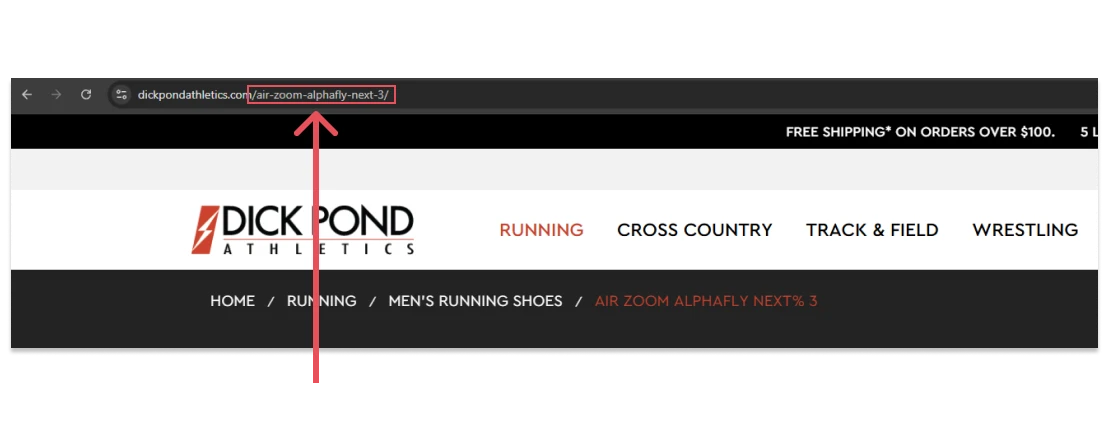 Example of short descriptive URL
Using SEO-Driven Keyword Research for Product Pages
One of the biggest mistakes eCommerce businesses make is not optimizing product pages for search intent. Many store owners either stuff too many keywords into their content or fail to include high-ranking, relevant keywords altogether.
Keyword research is the foundation of effective product page SEO. Choosing the right keywords ensures that your product pages show up when customers search for related products. The key is to find high-volume, low-competition keywords that align with what users are searching for.
Instead of just using broad, generic keywords, focus on long-tail keywords that mimic real customer searches. A generic keyword like “running shoes” is highly competitive, while a specific, intent-based keyword like “best running shoes for marathons” is easier to rank for and attracts more qualified traffic.
Enhancing On-Page Content for Better Rankings
Many eCommerce businesses rely on generic manufacturer descriptions for their product pages. Shared manufacturer specifications are common and do not automatically cause an SEO penalty. Add accurate product-specific descriptions and context that helps buyers, and review canonical signals where several URLs expose the same content.
Product descriptions should be detailed, informative, and engaging. They should answer customer questions, highlight key product features, and incorporate naturally placed keywords that align with user intent. Instead of simply listing technical specifications, product pages should tell a compelling story that persuades potential buyers.
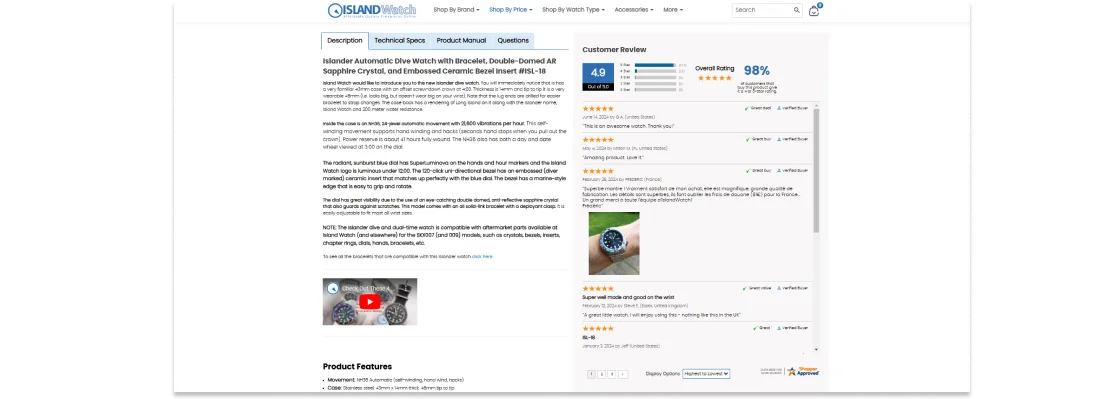 Example of Detailed Product description
Leveraging Interlinking to Improve Navigation and SEO
Interlinking plays a critical role in helping both users and search engines navigate a website more effectively. When a product page links to relevant categories, blog posts, or other related products, it increases website user engagement and improves page authority.
A well-structured interlinking strategy ensures that users stay on the site longer, reducing bounce rates and improving overall website credibility. For example, linking from a running shoe product page to a related guide on “How to Choose the Best Running Shoes” keeps visitors engaged while providing valuable content that enhances their shopping experience.
Final Thoughts on Product Page Optimization
Many eCommerce businesses overlook the power of SEO-driven product page optimization, leading to missed opportunities for organic traffic and conversions. A product page is more than just a place to list an item, it should be optimized for search intent, structured for easy navigation, and designed for maximum engagement.
Focusing on URL structure, keyword usage, interlinking, content quality, page speed, and structured data ensures that product pages rank well, attract the right audience, and convert visitors into customers.
For eCommerce businesses struggling to see results, implementing these SEO strategies can make a significant difference in search rankings and overall sales. With the right approach, product pages can become high-performing assets that drive long-term success.
At MAK Digital, we specialize in SEO-driven solutions that help businesses optimize their product pages for maximum visibility and conversions. Whether you need **custom development, keyword strategy, or technical SEO enhancements**, our team can help you build a high-performing eCommerce site. Contact us today to start optimizing your product pages and drive real growth!
Product page SEO checks you can act on
Start with representative product pages, including products with variants, products that are temporarily unavailable and products linked from several categories. Record the URL, issue, proposed change and validation step.
Match the page to the product and buyer
Use a clear title and main heading that identify the product. Add the specifications, compatibility information, dimensions, use cases or care details a buyer needs. Avoid arbitrary word counts. Reusing manufacturer specifications is not automatically a penalty; useful product-specific context helps distinguish the page and answer questions.
Write metadata and keep internal links consistent
Check that the title and description describe the actual offer. Use descriptive links from relevant categories and related products. Confirm links reach the intended product URL without avoidable redirect chains. Do not change an established URL just to add a keyword without considering redirects and existing links.
Illustrative product copy example
For a hypothetical stainless steel insulated bottle, a helpful description could explain capacity, lid type, cleaning method and dimensions. Those details must come from the actual product record. This illustrates the questions to answer; it is not a MAK Digital client result or a claim about a real product.
Review images, variants and structured data together
Use images that show the product and relevant details, with concise alternative text where it helps describe the image. Check image dimensions and delivery performance. Decide how size, color or other variants are represented in URLs and canonical signals. If product structured data is present, ensure price, availability and other marked-up facts match the visible page. Validate the implementation rather than assuming every variant needs a separate indexable URL.
Plan unavailable and discontinued product handling
Distinguish temporary stock changes from a permanently discontinued item. Consider whether the page still helps customers, whether a genuinely equivalent replacement exists and what existing links point to it. Choose the response and any redirect deliberately; sending every removed product to a category is not a universal solution.
Use website and technical SEO audit services to discuss catalog-wide template issues, or SEO services for ongoing product and category work. Keep the acceptance check alongside each proposed edit.
Product page SEO questions
How long should an SEO product description be?
Use enough accurate detail to answer the buyer's questions. There is no useful universal word count for every product. Specifications, compatibility and use information should come from the actual product.
Should every product variant have an indexable page?
That depends on how variants are presented and whether separate pages serve a useful purpose. Keep URLs, canonical signals, internal links and structured data consistent with the chosen approach.
Does manufacturer copy automatically cause a penalty?
No. Shared specifications are common. Add accurate, useful context where it helps customers, and review canonicalization where the site exposes several URLs for the same content.
Should I change a product URL to include another keyword?
Do not make that change automatically. Consider existing links and search visibility, then plan an appropriate redirect and internal-link updates if the URL really needs to change.
How should an out-of-stock product page be handled?
Distinguish a temporary shortage from permanent removal. Consider ongoing customer value, replacement products and existing links before deciding whether to keep, remove or redirect the page.
Can product markup guarantee a rich result?
No. Markup should describe the visible product accurately and pass validation, but valid structured data does not guarantee a particular search appearance.