How We Built a SaaS Marketing Site on WordPress
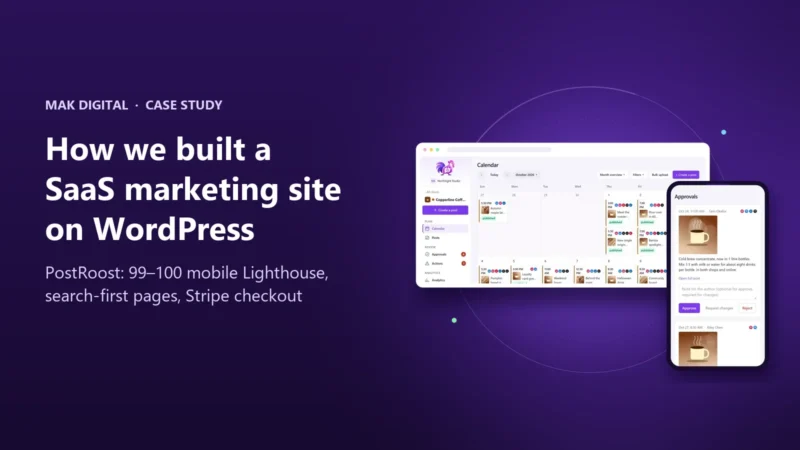
The decisions behind the PostRoost marketing site: why it is separate from the app, how the theme stays fast, how search intent…
Read More: How We Built a SaaS Marketing Site on WordPressPeople shopping for coffee search by origin, roast, brew method and freshness long before they type a roaster's name. MAK Digital builds coffee SEO around those searches: collections for Ethiopian naturals and dark-roast espresso, lot pages that keep their value after the harvest sells out, subscription pages search engines can actually read, and wholesale pages for the cafes and offices looking for a supplier.
15
Fifteen years of building, migrating, and growing online stores for B2B and B2C brands.
30+
SEO, AI search, paid media, design, and development experts under one roof.
USA
A US-based core team you talk to directly, backed by vetted specialists worldwide.
4.9
Average score across 650+ verified client reviews.
Coffee SEO services
A roastery's website is a rotating catalog of lots, a subscription business, a coffee school and often a wholesale desk too. Each part brings its own searches and its own page types, so our eCommerce SEO work for coffee roasters is split the same way.
Collection pages for the ways coffee drinkers actually narrow down a bag: country and region, washed or natural process, light to dark roast, espresso or filter, whole bean or ground, decaf and pods. Each one gets its own intro copy and internal links, not just a filtered product grid.
Product pages written for each coffee: tasting notes, producer and region where the roaster can verify them, process, altitude and variety where known, roast level, the roast-date and shipping policy, and brew recommendations, so an Ethiopian natural and a Brazilian pulped natural never share one recycled paragraph.
Grind, bag size and roast options kept on one product URL with clean canonicals, and a written policy for micro-lots and seasonal coffees that sell out, so links and rankings move to the next harvest instead of disappearing into 404s.
Crawlable pages for coffee subscription, roaster's choice, single-origin of the month, espresso subscription and gift subscription searches, instead of relying on a subscription app widget that usually carries little indexable text about frequency, bag size or cancel terms.
Pour-over, French press, AeroPress, cold brew and espresso guides, grind charts and origin explainers written with input from your roasters, linked into the collections they support and planned so they do not compete with those collections.
Product and Offer markup with roast, origin and process as additional properties, review markup only where real reviews exist, and feed titles that put origin, roast and bag weight where Google Shopping and free listings can use them.
Indexable wholesale pages for cafes, restaurants, offices and private-label buyers, plus Google Business Profile and location pages for roasters who also run a cafe or tasting room.
Search intent
Coffee search splits into lanes, and each lane is best served by a different kind of page. A roastery site that treats them all as "coffee" tends to end up with a homepage, an all-coffees shop grid and a blog, none of which matches a query like natural process Ethiopian or espresso subscription.
Searches such as Ethiopian Yirgacheffe, Colombian decaf, Kenyan AA or chocolatey low-acid coffee come from drinkers who already know what they like. They want an origin or flavor collection, or a specific lot page, that shows tasting notes, process and roast level at a glance.
Dark roast whole bean, medium roast ground, decaf espresso beans and compostable pods are shopping queries with clear filters built in. These belong on roast and format collections, not on product pages, so one page can rank for the whole group of coffees that fit.
Best coffee for cold brew, espresso beans for a home machine and pour-over ratio sit between learning and buying. A brew guide answers the how-to question; a brew-method collection answers the which-coffee question. Both need to exist and link to each other.
Coffee subscription, fresh roasted coffee delivered, coffee gift box and gift subscription searches carry recurring and seasonal intent. They need dedicated landing pages that explain frequency, bag size, pause and cancel terms, and gift options.
Wholesale coffee supplier, office coffee service and private label coffee roaster are B2B searches with a long sales cycle. Coffee near me and coffee roaster plus a city name are local searches that only matter if you run a cafe, tasting room or retail counter. Both get their own pages, kept apart from the national online shop.
Collections
For many coffee roasters, collection pages are the strongest candidates for non-brand searches, because one well-built collection can answer a query such as single origin light roast better than any individual bag can, and it stays live while individual lots come and go. Our planning starts with the taxonomy.
Build country collections first (Ethiopia, Colombia, Guatemala, Kenya, Sumatra and so on), then region pages only where you stock enough lots to support them. Process collections for washed, natural and honey coffees work well for roasters whose buyers already talk in those terms. Each collection gets a short, specific introduction: what that origin or process tends to taste like in your cups, and which brew methods you suggest.
Light, medium and dark roast collections, plus whole bean, ground, pods, instant and decaf (Swiss Water or other methods, named only as you actually use them). These match the plain-language searches that newer coffee buyers make.
Espresso, filter and pour over, cold brew and French press collections let you rank for "best coffee for" queries with a page that actually sells. Tag each coffee to the methods your roasters recommend, so the collection reflects real brewing advice rather than every product in stock.
Decide which combinations deserve an indexable page and which stay as on-page filters. A dark roast decaf collection may earn its place; every possible combination of origin, roast, grind and bag size does not. Filter URLs that create near-identical pages, such as a 2 lb bag filter on top of a Colombia collection, should be kept out of the index with canonicals or crawl controls.
Product pages
A coffee bag page has more to say than most product pages, and roasters usually have the facts already on a cupping sheet or an importer's spec sheet. The task is getting those facts onto the page as readable text.
Whole bean, drip grind, espresso grind, 12 oz and 2 lb options should be variants of one product, not separate products with copied descriptions. On Shopify that means product variants, with variant URLs canonicalised to the product; on BigCommerce it means variant options on one product, and on WooCommerce a variable product with grind and size attributes. Pods or cold-brew packs that people search for separately can justify their own product page. Our Shopify SEO, BigCommerce SEO and WooCommerce SEO services cover the platform-specific setup.
Micro-lots and seasonal coffees sell out by design, and fresh-crop arrivals from different origins land at different times of year. Agree a rule before the next harvest: a lot that returns each year keeps its URL with "back with the next harvest" messaging and a link to similar coffees; a one-off lot that earned links is redirected with a 301 to its successor or origin collection; a lot with no links or traffic can simply be retired. Holiday blends and gift sets get their landing pages built and indexed weeks before the gifting season, not on the day they launch.
Subscriptions and content
For many coffee roasters the first bag is a trial and the subscription is the real goal. Yet the subscription is often the weakest page on the site for search: a pop-up or app widget with little text and no stable URL.
Give each subscription offer its own crawlable landing page: a main coffee subscription page, then roaster's choice, single-origin rotation, espresso and decaf plans, and gift subscriptions where you sell them. Each page explains in plain text how often bags ship, which sizes are available, whether buyers choose the coffee or the roaster does, and how to pause, skip or cancel. The app handles checkout; the page handles search.
Brew guides are where coffee drinkers learn, and they attract the links that collections rarely earn. Write them from your own bar and roastery: the ratios, water temperature and grind settings your team actually uses, photos of your own equipment, and a named author with real coffee experience. Each guide links to the collection it supports (a cold brew guide to the cold brew collection, an espresso dial-in guide to espresso blends), and each collection links back.
A guide titled best coffee for French press and a French press collection can end up competing for the same query. Give the commercial query to the collection and let the guide target the method question (how to make French press coffee). Our content marketing service plans topics against the collection map so each coffee query has one clear owner.
Wholesale and cafes
Two buyer groups sit outside the national online shop: businesses buying coffee by the case, and people looking for a cup or a bag nearby. Each needs its own pages.
Cafe owners, restaurant buyers and office managers search for wholesale coffee supplier, office coffee service and private label coffee roaster, often with a region attached. Build indexable wholesale pages for each audience: what you supply, minimum orders, delivery area, equipment and barista training support if you offer them, and a sample or quote request form. Keep wholesale price lists behind a login, but make the landing pages public. Our B2B SEO services cover the wholesale side, from supplier-search pages to sample request tracking.
If you pour coffee on site, coffee near me and coffee roaster plus a city name start to matter. Set up Google Business Profile with Coffee shop or Cafe as the primary category and Coffee roasters as a secondary category where it is accurate, keep hours, the menu and photos current, and reply to reviews. Add a location page with the address, hours and directions, marked up with CafeOrCoffeeShop schema. A coffee shop without an online store is better served by our local SEO program than by this one.
Structured data and AI
Structured coffee data feeds three places at once: rich results in Google, Shopping and free listings, and the AI assistants that now answer questions about which roaster to try.
Use Product and Offer markup on every bag page, with price, availability and bag weight. Add roast level, origin and process as additionalProperty values, and use ProductGroup with variant markup where your platform supports it, so grind and size options are understood as one coffee. Add AggregateRating only when it reflects real reviews shown on the page. Our post on eCommerce schema markup goes into detail.
Feed titles such as "Colombia Huila Washed, Medium Roast, Whole Bean, 12 oz" match how coffee is searched far better than a lot nickname on its own. Group grind and size variants under one item group, keep availability in sync when a lot sells out, and keep the feed and the page saying the same thing. Our Google Shopping management service covers feed work alongside SEO.
When someone asks an assistant for a fruity natural-process coffee for pour over, the answer is built from pages that state origin, process, roast date policy and brewing advice plainly. Clear product facts, consistent schema and expert brew guides make it easier for those answers to describe your coffees accurately. Our answer engine optimization and generative engine optimization services cover this, and AI search optimization is part of MAK SEO plans from $2,000/month. No one can promise how an assistant will describe a brand; the work improves the source material it draws on.
Search to page
This is the planning map we use when matching coffee searches to page types on a roastery site.
| Search lane | Example queries | Page that should rank | What the page needs |
|---|---|---|---|
| Origin and flavor | Ethiopian natural coffee, Sumatra dark roast, nutty low-acid coffee | Origin or flavor collection, then lot pages | Tasting notes, process, roast level, verified sourcing details |
| Roast and format | medium roast whole bean, decaf espresso beans, compostable coffee pods | Roast and format collections | Clear intro copy, filters, links to brew methods |
| Brew method | best coffee for cold brew, pour over ratio, espresso beans for home | Brew-method collection plus a matching brew guide | Recommended coffees, ratios, grind sizes, links both ways |
| Subscription and gifting | coffee subscription, single origin of the month, coffee gift box | Subscription and gift landing pages | Frequency, sizes, pause and cancel terms, gift options |
| Wholesale | wholesale coffee supplier, office coffee service, private label roaster | Wholesale landing pages by audience | Supply details, delivery area, sample or quote form |
| Local | coffee near me, coffee roaster plus city | Google Business Profile and a location page | Hours, menu, photos, reviews, CafeOrCoffeeShop schema |
Go deeper
Related reading from the MAK Digital blog.
Why it differs
Coffee shares some ground with our broader food and beverage SEO, but roasters face problems that most food brands do not.
Coffee lots arrive and sell out on crop cycles, so URL policy for returning and retired coffees matters more than it does for a fixed grocery range.
Process, variety, altitude, roast level and tasting notes are search terms in their own right, and pages that leave them in a PDF cupping sheet miss those searches.
Labels such as USDA Organic and Fair Trade belong only on coffees with the certification behind them, and phrases like low acid or claims about caffeine should be backed by evidence. Compostable or recyclable pod claims fall under the FTC Green Guides, so we write that copy from your packaging supplier's documentation and leave legal review to your counsel.
For brands that also sell tea, matcha, oolong and first-flush Darjeeling map to the same type, origin and harvest structure, so the same collection, schema and subscription approach carries across.
Standards
These are the standards we would check on a roastery site before any new content or link work.
MAK Digital is an eCommerce SEO agency founded in 2012, with 30+ in-house specialists and 800+ projects delivered. We are a Google Premier Partner and a BigCommerce Elite Partner. Here is how we would approach a roastery site.
We crawl the store on Shopify, BigCommerce or WooCommerce and list duplicate lot descriptions, variant URLs, dead pages from past harvests, filter bloat and schema gaps, and check how your subscription app renders.
We sort your target searches into origin, roast, brew-method, subscription, gifting, wholesale and local lanes and assign one page to each, flagging where a guide and a collection compete.
Collection taxonomy, variant canonicals, sold-out lot rules, product schema and Merchant Center feed titles are put right first, because content built on a messy catalog will not hold its rankings.
We write collection intros, lot page templates, subscription landing pages and wholesale pages with your roasters' input on tasting notes and brewing advice.
Brew guides and origin explainers go out on a plan tied to harvest arrivals and the gifting season, and monthly reporting shows rankings, organic revenue and subscription sign-ups by page lane.
Reviews from the businesses whose websites and search programs we run.
John
Pool & Hot Tub Depot
★★★★★
“Working with this team has been an absolute pleasure! Their dedication to creating successful e-commerce stores is unmatched. We collaborated seamlessly, and their expertise helped us achieve outstanding results. Our online store has seen tremendous growth and success thanks to their guidance and support. Highly recommended!”
Arman
Glowback, glowbackledstore.com
★★★★★
“Launching and managing an e-commerce store can be daunting, but this team made it simple and stress-free. Their comprehensive approach, from website design to marketing strategies, ensured a seamless and engaging customer experience. Our store's performance surpassed our wildest expectations, thanks to their expertise and dedication. Working with them was truly a game-changer for our business.”
Sanzo Specialties
★★★★★
“Mary and the MAK team had a clear vision for our website on the initial consultation, also transparent pricing. After committing to the project, there was great collaboration on both design and function. Very pleased with the end product!”
We will review your collections, lot pages, variants, subscription pages and schema, and show which coffee searches your site could be ranking for.
Answers to the questions coffee roasters and coffee brands ask most about search.
Give a lot its own page when it has distinct demand and enough to say about it: a named producer, a notable process or a coffee you bring back each year. Short-run lots can sit inside their origin collection. Whatever you choose, decide in advance what happens to the URL when the lot sells out.
Keep one product URL per coffee and offer grind and size as variants, with canonical tags pointing variant URLs to the main product. Only create a separate product when the search intent really differs, for example pods or a cold-brew concentrate, not just a different grind of the same beans.
It can bring more of the right visitors to the subscription offer. That depends on having crawlable subscription pages that target searches like coffee subscription, single origin subscription and coffee gift subscription, with the terms written out. Results depend on your offer, competition and site, so we report on sign-ups from organic search rather than promise a number.
If the page is simply deleted, any rankings and links it earned are lost. Keep returning coffees live with next-harvest messaging and links to similar lots, and 301 redirect one-off lots that earned links to their successor or origin collection. Avoid leaving linked lot pages as 404s.
Product and Offer on every bag page, with roast level, origin and process as additionalProperty values and variant markup for grind and size. Add AggregateRating only for real reviews displayed on the page. Cafe and tasting-room location pages use CafeOrCoffeeShop, which is a type of LocalBusiness.
Yes, because they are two separate intents. The cafe needs a Google Business Profile and a location page to show up for coffee near me searches; the online shop needs collections and product pages to rank nationally. We keep the two apart, so the cafe location page targets the city and the shop collections target origin, roast and brew-method searches nationwide.
It can put your roastery in front of cafe owners, restaurant buyers and office managers searching for a wholesale coffee supplier, office coffee service or private label roaster. That needs public wholesale landing pages for each buyer type, with what you supply, minimum orders, delivery area and a sample or quote request form, while price lists stay behind a trade login. We track sample and quote requests from organic search rather than promise a number of accounts.
Yes. Tea follows the same eCommerce SEO method: collections by type and origin (green, black, oolong, matcha, herbal), harvest and flush details on product pages, loose-leaf versus bagged variants, schema and subscription pages. Brands that sell both coffee and tea can run them as parallel collection trees on one site.
From the eCommerce Experts
The decisions behind the PostRoost marketing site: why it is separate from the app, how the theme stays fast, how search intent…
Read More: How We Built a SaaS Marketing Site on WordPressWinning now means treating discovery as a product data problem, not only a rankings problem. AI SEO for eCommerce is the discipline…
Read More: AI SEO for eCommerce: The Complete 2026 Strategy for Online StoresOnline shopping is starting to move from “type a query, scan a product grid, open ten tabs” toward a more delegated path:…
Read More: Agentic Commerce Explained: How AI Agents Will Buy From Your StoreTwice a month: what changed in Google and AI search, what it means for your store, and exactly what to do about it. Written by the people who build and rank stores for a living.
First issue lands within two weeks. Check your inbox for a hello from us in the meantime.